


“Bicycles came in hordes, like locusts, upon the university towns. The bicycle is one of the main causes of traffic congestion. A few locusts are of little importance. A swarm is a plague.”
That sounds like a warning against the cycling city. It is the reverse: the planner Thomas Sharp, on Oxford, in Oxford Replanned, 1948. He was complaining that Britain had too many bikes.
Almost every British town and city was a “cycling city” within living memory. By 1936 we owned over 10 million bicycles and 1.8 million cars. Then came the great swap, two wheels for four, and Edinburgh made it in plain sight: driving to work climbed from 28% in 1971 to 45% by 1991. It never came back down. Home working has receded since the pandemic and the car took the returning commuters with it: two-thirds of Scots who travel to work still drive, a bigger share than in 2011.
We did not stumble into this; we planned it. Cities were redrawn, towns were built, railways ripped up and services pushed to the edges, all on one assumption: everyone drives.
“If you asked a politician whether a new hospital should be inaccessible to one-fifth of the population, obviously they’d say no,” says Alan Tapp, who studies how driving bends our judgement. Build it on the edge of town instead and few see a problem. Neighbourhoods sprawled. High streets emptied. The car did not just fill our roads; it rebuilt our lives around itself.
The Edinburgh Royal Infirmary left an easy-to-get-to, city centre site, next to the Meadows, for poorly connected, car-bound Little France in 2002.
And it rebuilt our heads. We can name it: motonormativity, or “car brain”. 75% of Britons agree nobody should smoke where others must breathe the fumes; change two words to car exhaust and only 17% agree. A society built for one machine starts to feel like the way things have always been.
It is not. We built it inside two generations, and here it is already slipping. Fewer than half of Edinburgh’s commuters drive, less than any other Scottish city, and this May Spokes counted single-occupancy car use at a record low. What was built can be unbuilt. This part is the alternative: what a cycling city is, and the proof it works in harder places than ours. In part one of our series, we looked at why it is needed.
The Eight-Year-Old Test
A cycling city is not one where everyone cycles. It is one where anyone can: an eight-year-old, a pensioner, a wheelchair user, without a second thought. Trams, buses and trains cover the distance, and the car is kept for the journeys that need it: the trades, the carers, the weekend’s Munro bagging.
What the bike takes is the middle. Too far to walk, too short to be worth a car. The commute. The school run. The food shop. The gym. The football. The daily trips which can easily be substituted, making us happier, healthier and less poor.
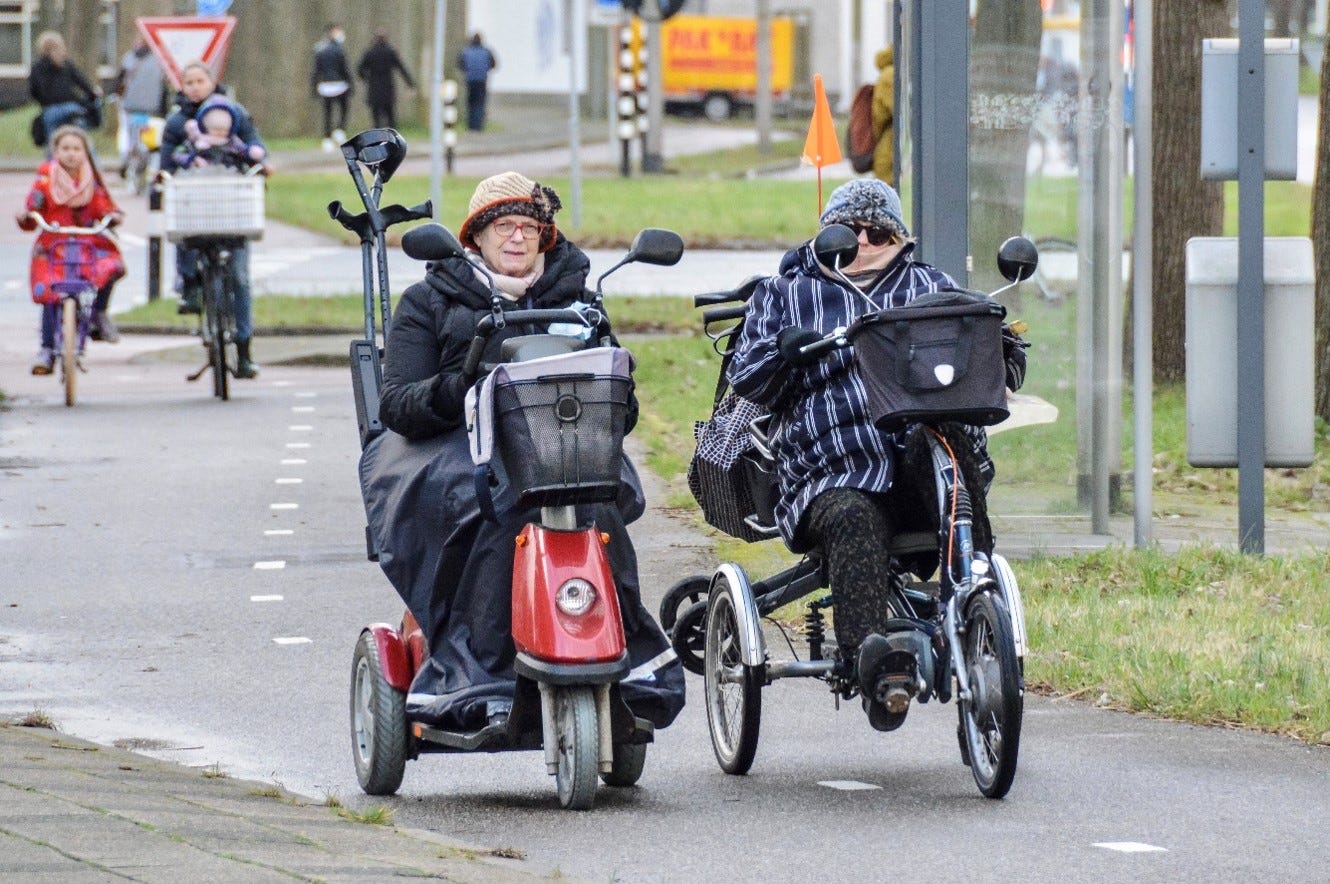
Forget the lycra look. People ride for the same reason you drive: it is the easiest, fastest, and cheapest way to get around. Transport is the second biggest bill a household pays after housing; a bike shrinks it to pocket money each month. That is transport poverty cut at source, and opportunity opened up.
Fewer engines: quieter streets, cleaner air, children on the school run under their own steam. Less parking: space handed back to people, and better places to eat, meet and shop: customers on foot linger and spend, drivers only pass through.
“A city can be friendly to people or it can be friendly to cars, but it can’t be both,” said Enrique Peñalosa, the mayor who rebuilt Bogotá. If you never touch a bike, you still win: every one on the road is one less car in the queue ahead of you.
The Supposed Transport Hierarchy
Scotland’s transport hierarchy, set in 2020, ranks walking and wheeling first, then cycling, then buses and trains, and the single-occupancy car last. Given its well-documented harm to our society, the thing we built our lives around should be the lowest priority.
I’ll let you make up your own mind whether that is true.
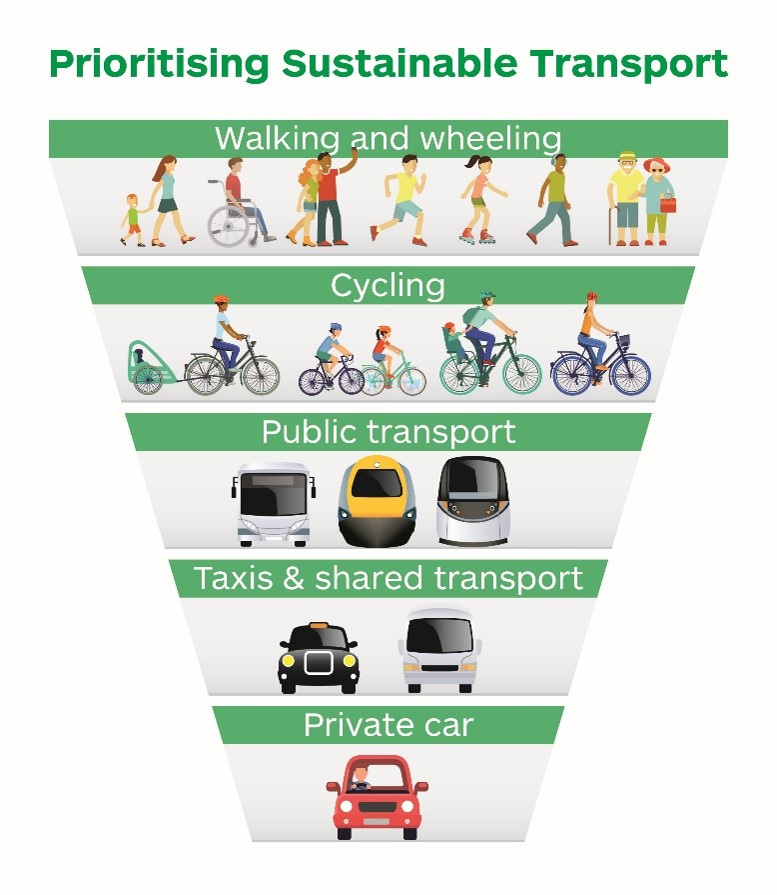
Cycling earns the ranking on merit: three times faster than walking, up to five times as many people down a single lane, and 27 times less energy than a car (the engine is you, running on breakfast). Most urban car trips are short, 26% under five kilometres. In Edinburgh, walking and cycling already prevent nearly 1,400 illnesses a year and deliver £336.7 million in benefit.
And none of that changes with an electric car. Same congestion, same parking space, no less lethal outside a school.
The Small Print
The hierarchy says one thing; the money says another. Scotland’s 2026-27 draft budget gives active travel around £163 million, 3.9% of transport spending, below 4% for the first time in five years and a long way from the 10% we were promised in 2021. Trunk roads go up by nearly £90 million, a rise the government’s own carbon assessment rates “high negative” for the climate. We pour billions into the mode we have declared comes last, and starve the ones we say come first.
It is not just the amount. I work in active travel, and the deeper problem is how the money arrives. Roads get multi-year funding; you can plan ahead. Active travel comes one financial year at a time.
Councils bid in January 2026 for money to spend between April 2026 and March 2027, and at time of writing (August) those bids are still unanswered, delayed in part by May’s election. The deadline has not moved with them. Whatever is finally awarded must still be designed, consulted on, built and paid for by 31 March 2027, or handed back.
Councils and consultancies struggle to build experienced, well-resourced teams that way, sitting idle waiting for a decision and then scrambling, unsure if funding is coming the following year. And the region is carved up between authorities, each with its own small team and its own residents to answer to. A council’s remit ends at its boundary.
A commuter’s journey does not. So the routes that should link us rarely get built.
The promises keep lapsing too. In 2009 Edinburgh signed the Charter of Brussels, pledging 15% of trips by bike by 2020; we are at a third of that. The 2021 Bute House Agreement promised a fixed share of the transport budget for active travel, and never delivered it.
The Harder Places
None of this is theory. It has been done in cities hillier, colder, bigger and more car-bound than Edinburgh. In almost every case the recipe was the same: a crisis or a catalyst, then a politician who held their nerve and built the alternative before restraining the car.
Paris: The Bike Overtook The Car
Mayor Anne Hidalgo staked her office on the bike from 2014, then used the empty roads of lockdown to lay pop-up lanes in Paris which she later made permanent: €250 million of protected track, and more than a thousand kilometres of it since 2020. Cycling has more than tripled since 2010, and the bike has overtaken the car, 11.2% of trips against 4.3%. That took a decade, not a generation.
The city changed with it. Paris has closed more than 100 streets to traffic and taken out 50,000 parking spaces.
Its air is transformed: nitrogen dioxide down 50% since 2005, fine particles down 55%, and deaths attributable to air pollution down by a third between 2010 and 2019. Traffic is not the only cause, but Airparif puts it first. If a capital that size can do it, the idea that Edinburgh, a tenth of it, never could is hard to take seriously. Parisians re-elected Hidalgo in 2020, anti-car programme and all. And in March 2026 they went further, electing her former deputy Emmanuel Grégoire to carry the cycling plan on.
