

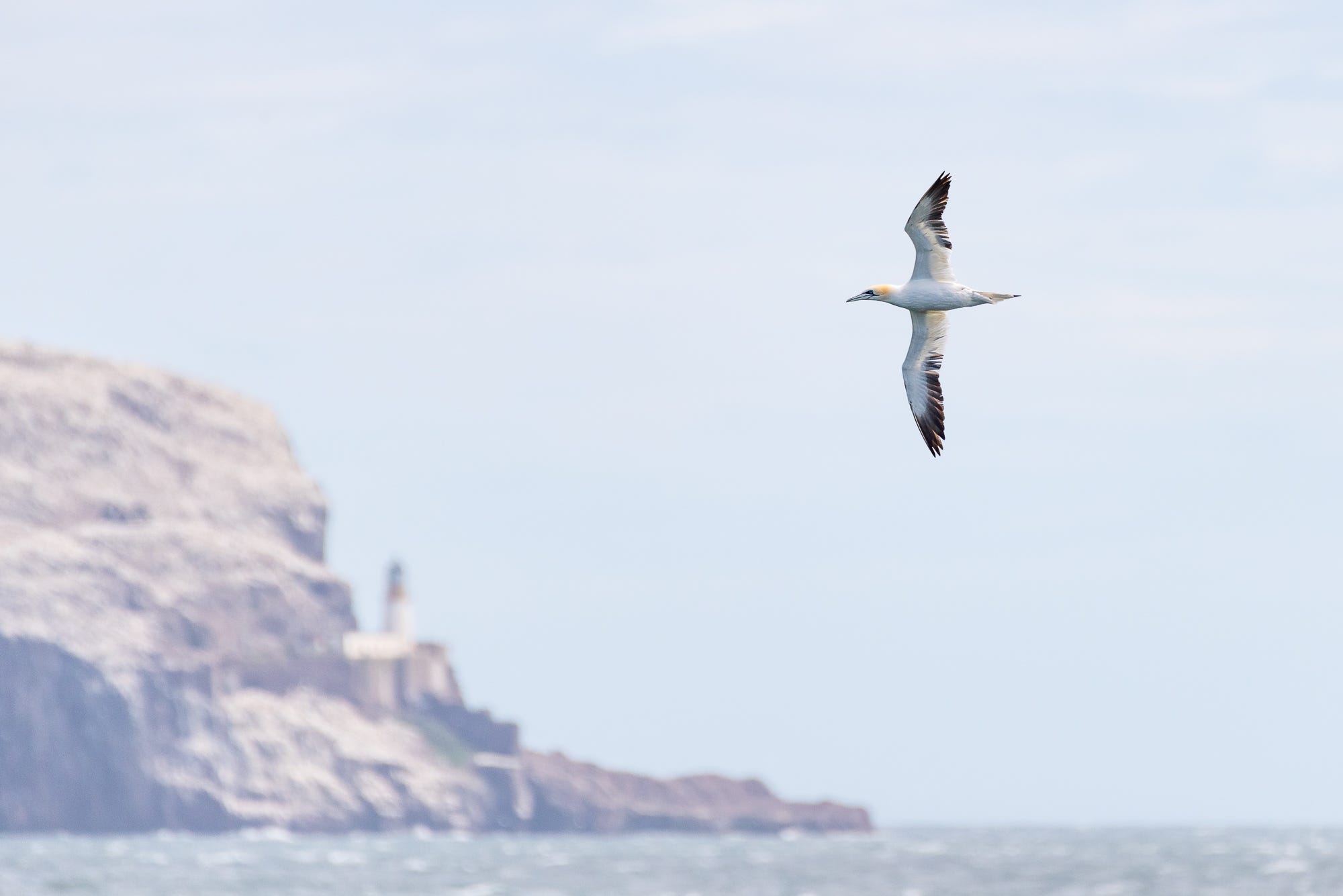
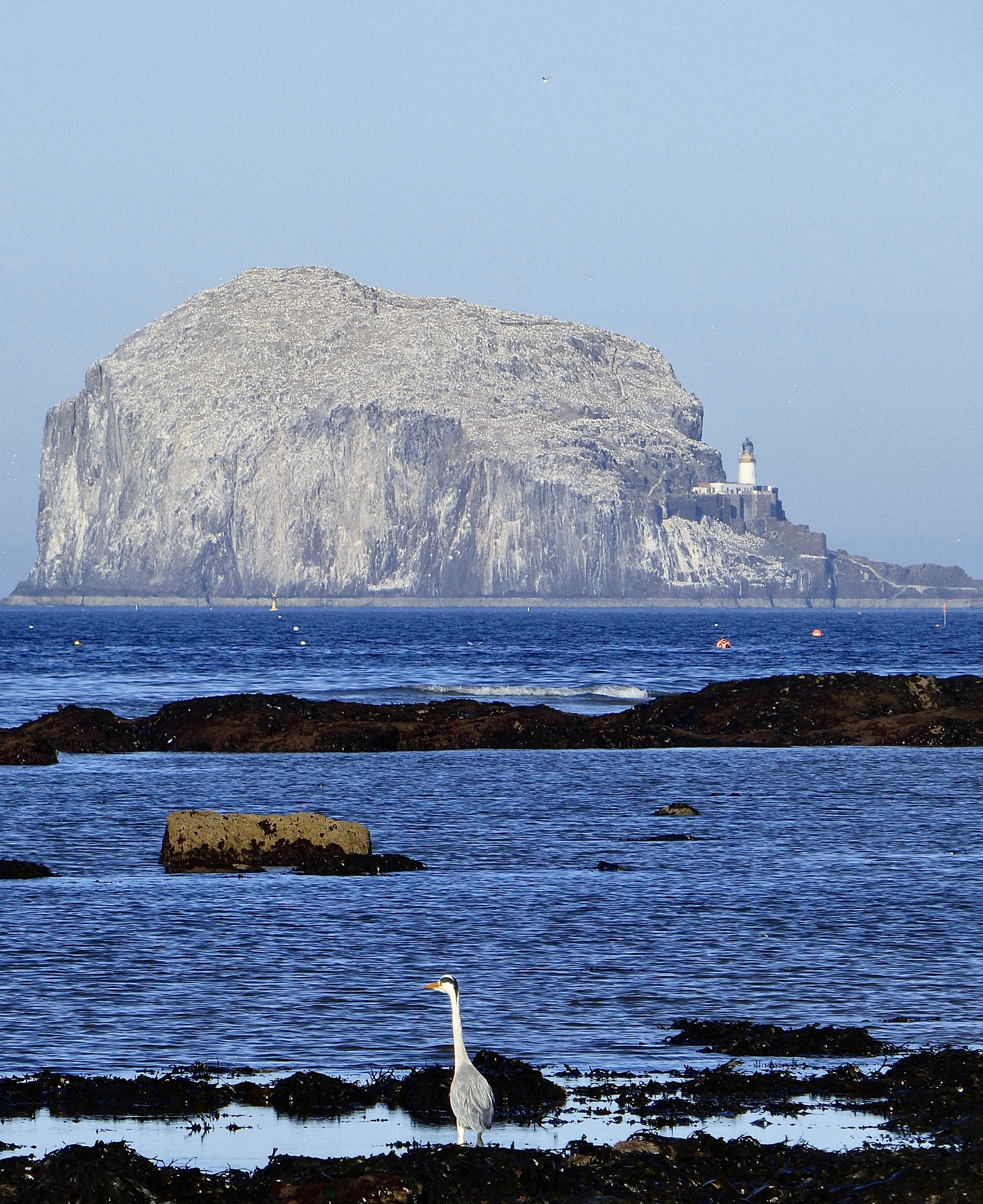
All nature-lovers have a visual marker of seasonal change that brings them joy and solace. For some, it’s the blousy pink of the cherry blossoms in the Meadows when winter’s retreating, while others are cooried by the Water of Leith trees turning gold in the autumn. For me, though, it’s seeing the Bass Rock getting its annual whitewash, writes Ashley Davies.
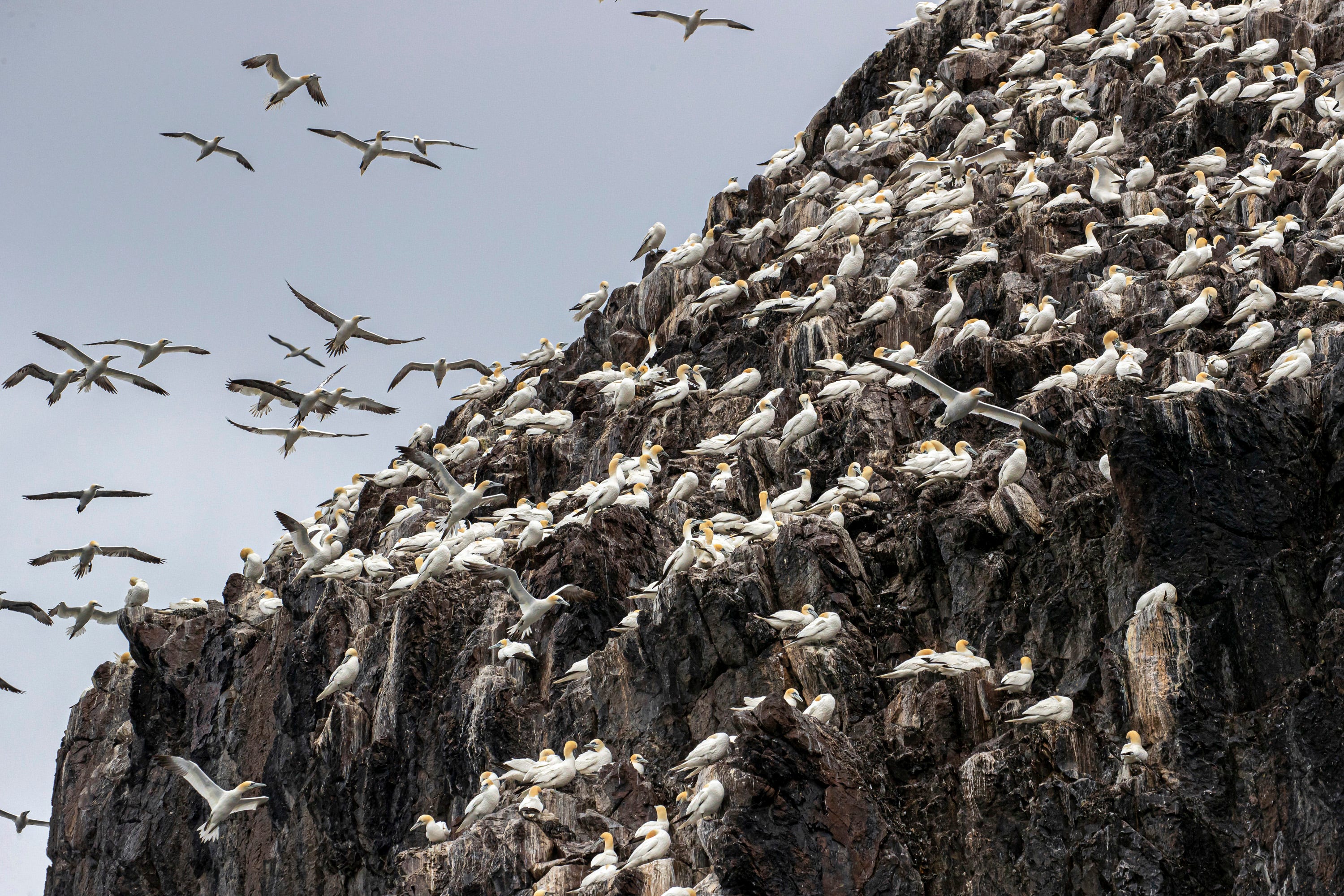
That transition from greyish brown means the northern gannets are back for the summer, giving the volcanic plug in the Firth of Forth its guano and feathers makeover. It means they’ve survived their gruelling migrations (some flying from as far as west Africa) to return to their chosen breeding ground. These glorious monogamous birds will be reacquainted with their life partners and will, fingers crossed, lay one egg. So much endeavour for a single guga.
To me, that chalky transformation, which you can see happening gradually from miles away, and whose ammonia stench can make your eyes sting when you’re up close, is a powerful representation of life, resilience and hope. It’s a reminder that remarkable wildlife isn’t abstract or something for kids to observe in zoos: it’s right in front of us, a constant visual signal that we humans are only a small part of the living world and we owe it our respect, appreciation and help.
The Bass Rock is one of the biggest colonies of northern gannets in the world. It was the biggest before the avian flu epidemic of 2022 killed about 30 per cent of them, and last year scientists counted 100,000 of them on the rock during peak breeding season.
The Bass is just over 100 metres high, but, depending on the tricks being played by light and clouds, it can sometimes feel twice as big. As is the case with Salisbury Crags, when you catch a glimpse of it from an expected angle, it can take you by surprise.
It’s funny to think of the Bass Rock belonging to anyone (though perhaps not as funny as knowing that the isle of Lamb, nearly four miles west, is owned by professional spoon bender Uri Geller) but until earlier this week it was the property of the Hamilton-Dalrymple family. They’d bought it 320 years ago from the Lauder family, and over the centuries its various uses have included being a prison and a hermitage.
And as of this week, it’s the property of the RSPB, which means what was already a site of special scientific interest (SSSI) will now be an official nature reserve. Thanks to a grant from the National Heritage Memorial Fund, the bird protection charity has acquired the Bass Rock, along with the nearby Craigleith island, which is home to 10,000 puffins in the summer, for £586,000.
Sir Hew Dalrymple, whose ancestor of the same name bought the Bass Rock in 1706, said he felt the RSPB would be in a better position to protect this precious place and its inhabitants from the numerous threats they face, among them climate change, bird flu and the planned building of enormous offshore wind farms dangerously close to where they fish. (The RSPB has estimated that the planned Berwick Bank wind farm, more than four times the size of Edinburgh, will kill around 4,000 seabirds in its first year, and the stopberwickbank.co.uk campaign has growing support to have it moved somewhere else).
You can read more about the giant Berwick Bank wind farm, the threat it poses to the birds of the Firth of Forth and the campaign to move it in Joe Coroneo-Seaman’s long-read It will kill 40,000 seabirds to help hit our Net Zero targets.
‘You can seen tenderness between couples’
The human politics of human land (and sea) ownership aside, it’s fascinating to watch close-up the way the gannets behave on their rock. Every spring they return to the exact same spot – almost within inches of the place they settled in the previous year. You see them squabbling over territory, often scissoring each other’s beaks so violently their eyes bleed.
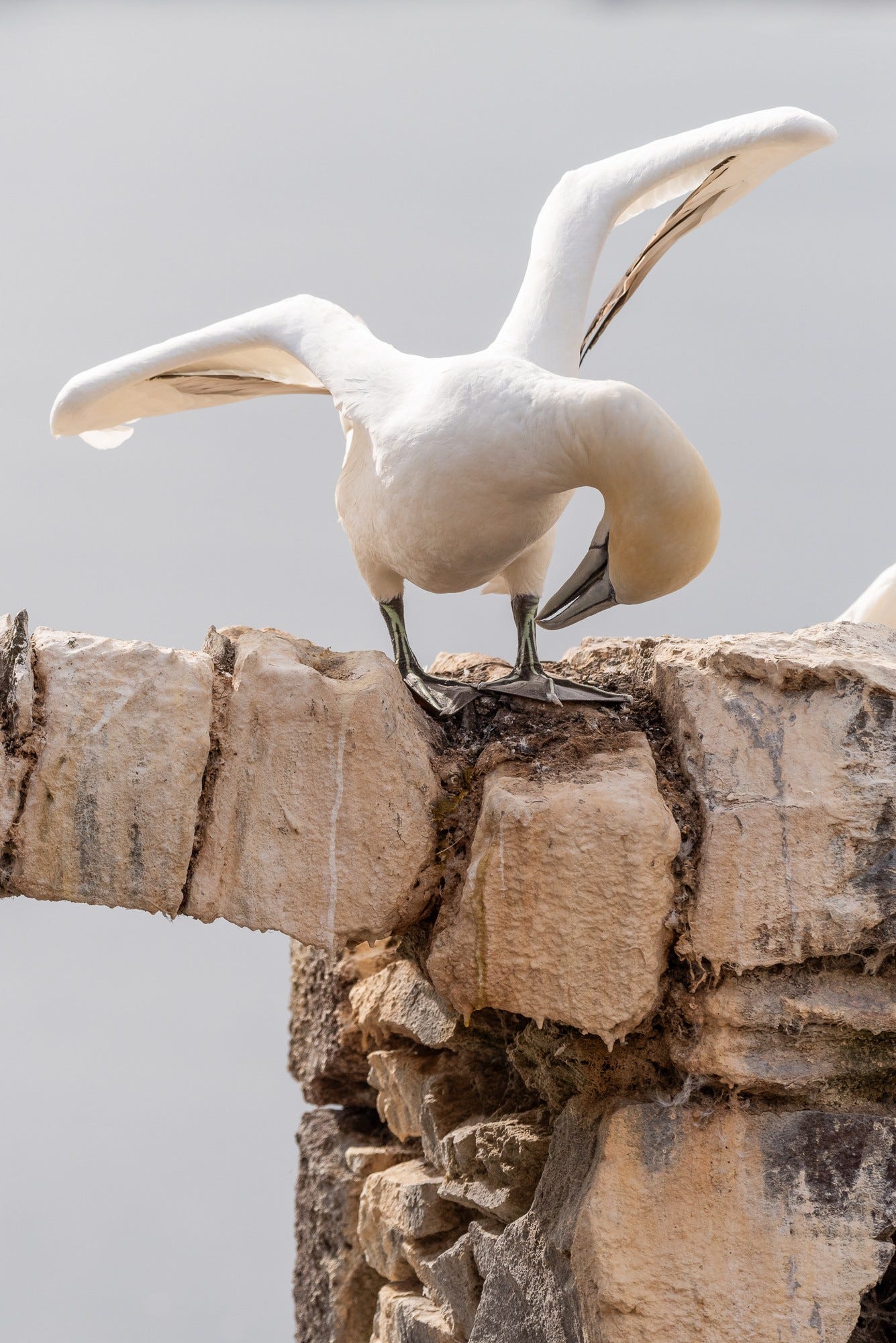
But you also see the tenderness between couples. Early on in the breeding season I spent a few hours on the rock, just beside the ruins of the chapel and about 30 metres up from the lighthouse built by David Stevenson in 1902. Gannets can live as long as 35 years, and the couples strengthen their bonds with bill-fencing (gently tapping beaks while pointing their heads up) and mutual grooming.
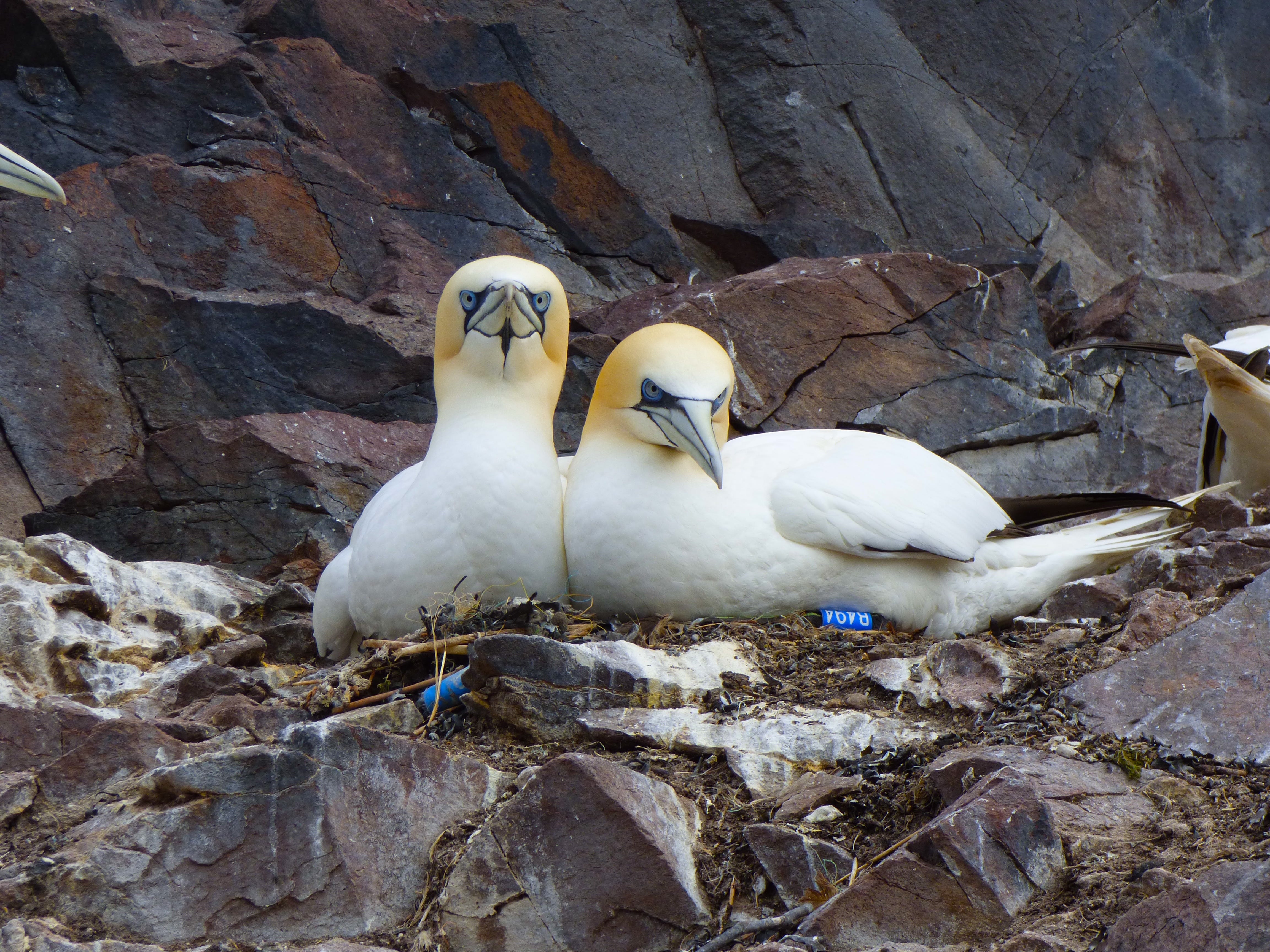
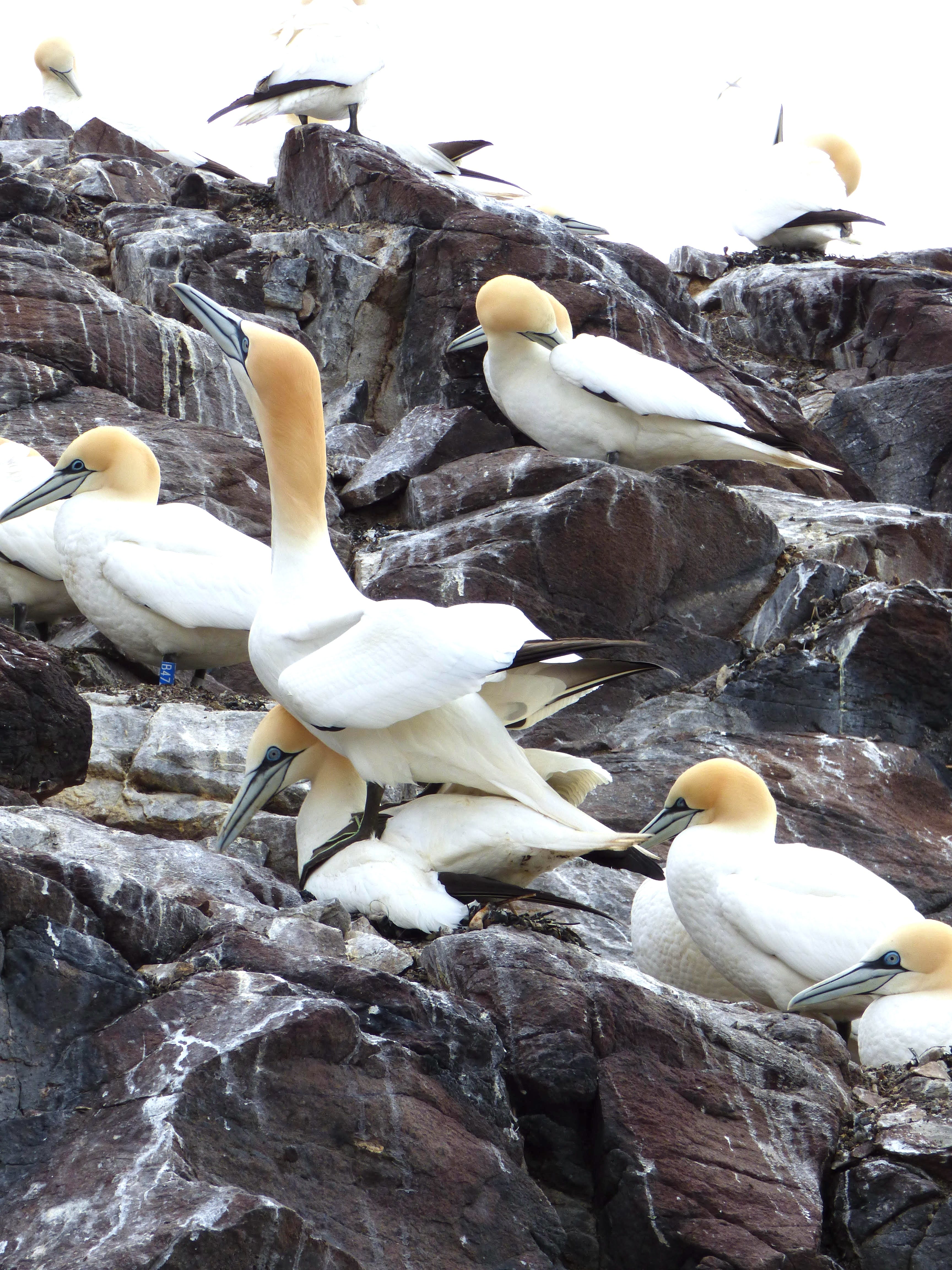
I sat quietly, just a few metres away from thousands of them, as one male brought his mate some seaweed for their nest, his gesture rewarded with some rough (his beak pinning her down by the neck) but mercifully short mating. Half an hour later he brought her the exact same gift and they got down to business once again. If she knew he was taking the mickey, she didn’t let on.
Majestic in the air as they are diving at speeds of up to 100kmh into the water to fish, they’re surprisingly ungainly on the ground: they land clumsily and waddle when they walk, and when it’s crowded or there’s not much wind it can take a while for them to get airborne. You can also see close-up which birds survived avian flu; their pale blue eyes have turned black – as scientists only discovered in recent years.
‘Nothing prepares you for the sound and smell’
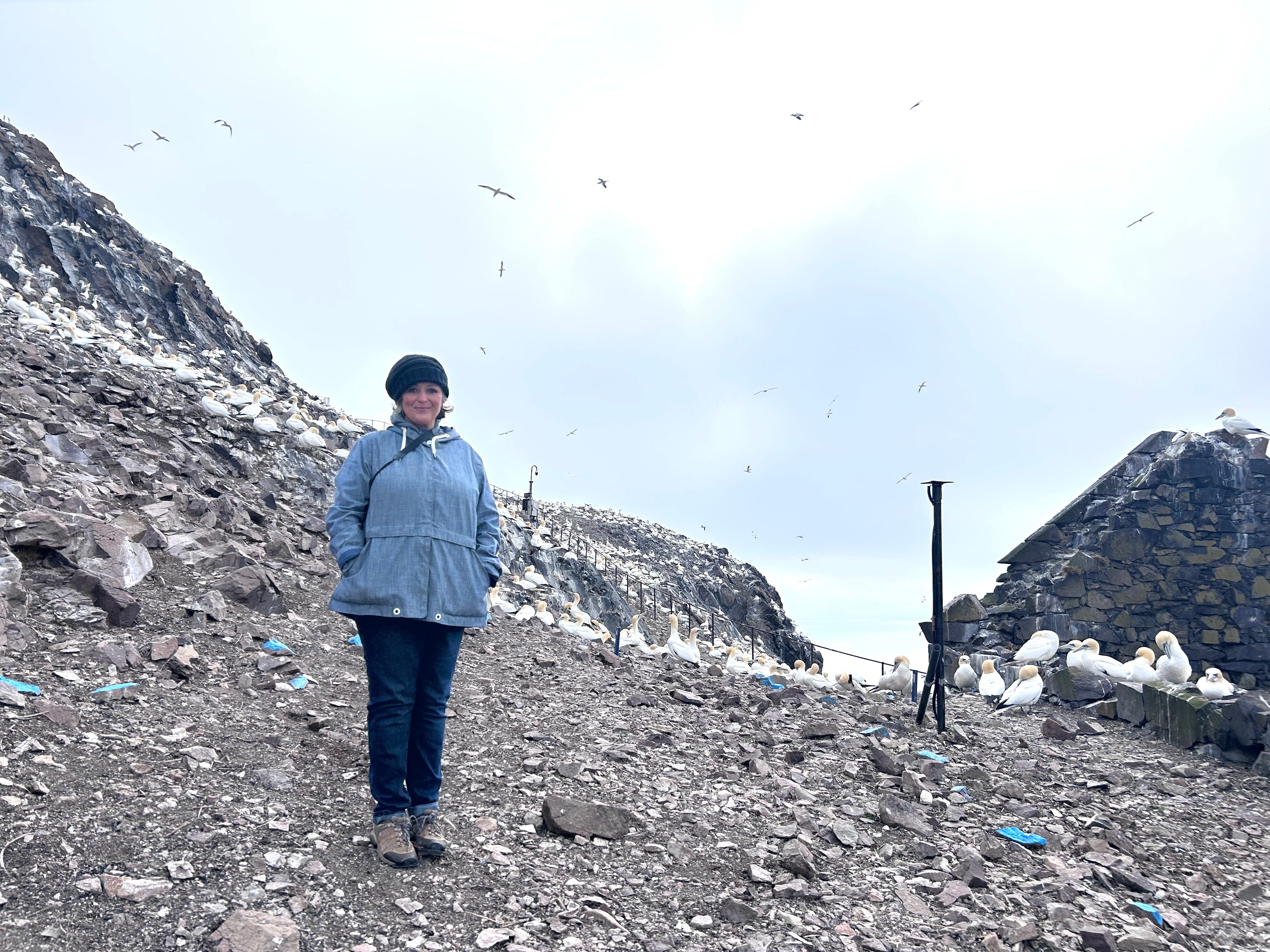
My landing trip was one of the carefully controlled visits organised by the Scottish Seabird Centre (SSC) and hosted by Maggie Sheddan, the rock’s passionate custodian who knows more about these birds – collectively and individually – than anyone.
The SSC also runs various cheaper trips around the islands. Although with most of them you don’t get to leave the boat, you do get close enough to feel as if you’re part of a nature documentary. Truly, nothing prepares you for the sound and smell, or for the sight of a fluffy guga on the edge of a rock. You’ll almost certainly also see seals, which swim in and out of the caves, as well as other seabirds such as guillemots, razorbills and shags – as well as the odd puffin, which would probably feel safer with the rest of its circus over on Craigleith.
On my most recent trip I saw a couple of stern-looking fulmars, which ward off danger with revolting, oily vomit that can kill a predating bird by eroding its feathers. Not much good for your clothes, either, so definitely keep your distance if you come across them.
This year’s Fringe by the Sea festival has some intriguing treats planned for gannet lovers. Vision Mechanics, the creative geniuses behind the ten-metre-high Storm puppet that walked through North Berwick in 2021, are creating a giant gannet puppet. It’ll lead a parade called The Flock, which starts near the harbour and heads up to the Lodge grounds on 31 July. At fringebythesea.com you can find details on how to get involved and make your own gannet puppet.
The procession will be part of the festival’s Love of Life theme, which also includes an immersive music experience created by Emmy Award-nominated composer Erland Cooper, inspired by his own time with the gannets (or solan geese, as they’re known in his native Orkney). You can experience it all inside a large nest-like art installation made by Naomi Mcintosh, where filmic footage of their trip to the island will also be projected.
More detail can be experienced at Love of Life – A Closer Look at the Scottish Seabird Centre (31 July-9 August), which also has a livestream from the colony that can be viewed anywhere from home or in 3D high definition panoramic display at its Discovery Experience.
Or you can simply sit on the beach in North Berwick and while away the hours watching the gliding and diving, and bringing fish back to that magical rock, which belongs to them.