


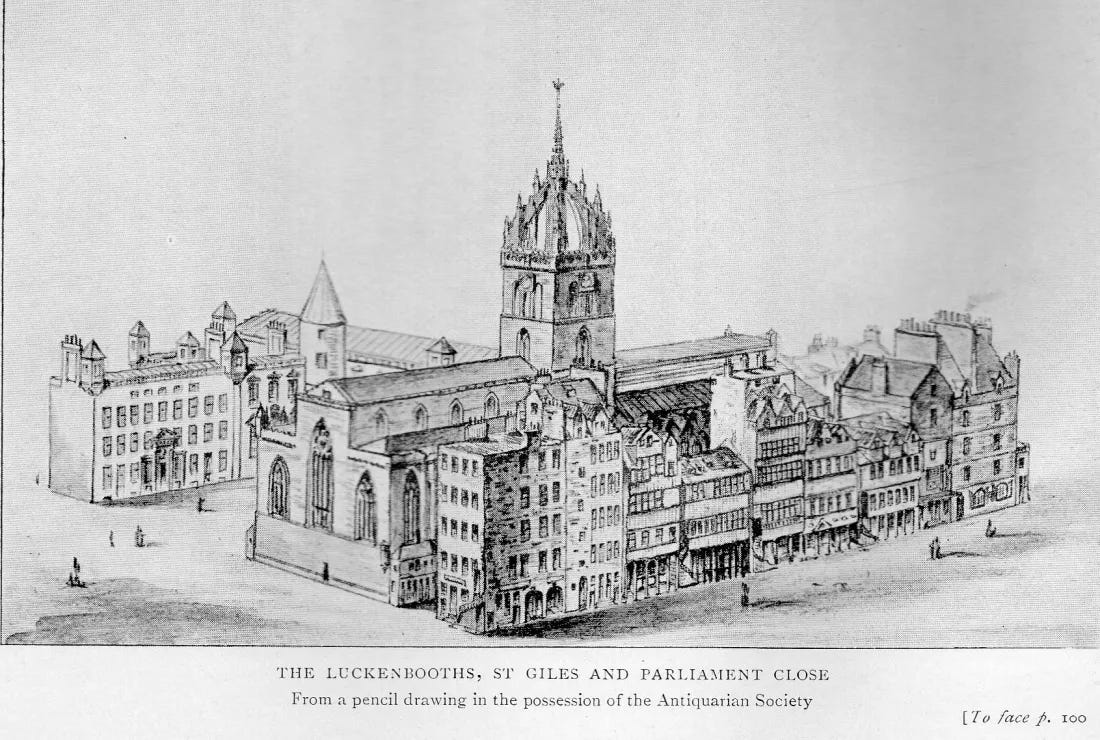
The Luckenbooths were once the commercial heart of Edinburgh. Gone now, but not lost to those willing to trace the city’s earliest permanent shops.
Many locals avoid the Royal Mile, passing through only out of necessity and hurrying past throngs of tourists and tartan-clad clothing rails. Yet centuries ago, this stretch of the High Street was where the city gathered: to worship, hear news, and watch - or endure - public punishment. Along the north side of St Giles’ Cathedral, residents traded in the dense market stalls of the Luckenbooths for almost 400 years.
For much of that time, there was little alternative. Until the mid-1700s, Edinburgh was a walled city, and its approaching 60,000 residents were hemmed into a space less than a mile long and less than a mile wide. Space was at a premium, and for shopping there were few options beyond the timber-fronted stalls that could be locked at night, situated mainly on the ground floor of what was a block of two-storey tenements. The name “Luckenbooth” comes from the Scots for “locked booth.”
Other markets existed, but they were limited. A market of bazaar style stalls and booths known as The Krames, also known as the “Stinking Stile” because of waste thrown from the surrounding tenements, offered cheaper goods. The Grassmarket or Leith docks served those seeking necessities or larger items.
The Luckenbooths, by contrast, were the key destination for traders. They offered higher-quality wares, greater variety, and reliability not found elsewhere. Merchants could also lock up their goods at night, a simple protection not guaranteed in other markets.
An Edinburgh Emblem
Jewellery was the earliest and best-known trade. Small silver and gold pieces, crafted by goldsmiths and silversmiths, were the first goods sold here. These jewellers produced and sold baubles and trinkets alongside more expensive items, to a city keen to display both faith and status.
Brooches were especially popular, worn by men and women alike to fasten cloaks and plaids. Over time, one style became so synonymous with the stalls that it took its name from them. The Luckenbooth brooch features two intertwined hearts and a crown, often referred to as the Heart and Crown of Scotland, and is linked to Mary, Queen of Scots. Many examples feature an “M,” said to reference the brooch she reportedly gave to Lord Darnley as a symbol of love and devotion.
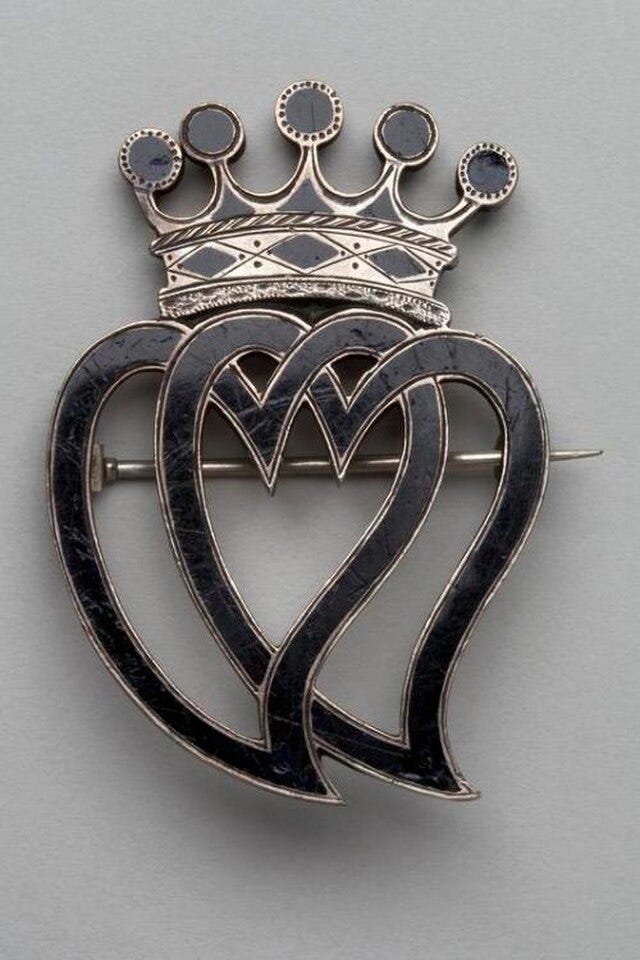
Despite the ill-fated outcome of that particular romance, the brooch became a tradition. A man would present a Luckenbooth brooch to his betrothed on their wedding day. When their first child arrived, the same piece of jewellery would be pinned to the baby’s shawl to protect it from “evil spirits.” Variations of the design are still sold on the Royal Mile today.
Books, Burns and Brodie
Soon, other traders followed. The High Street stalls came to house watchmakers, haberdashers, toymakers, stationers, and apothecaries. Wigmakers - known as perukers - also operated from the Luckenbooths from the 17th to the late 18th century, catering to Georgian demand for elaborate wigs worn by the fashionable and wealthy.
Scottish poet Allan Ramsay began his career as a successful wig-maker nearby. He apprenticed in the trade and eventually opened his own business. Around 1725, he gave up wig-making to focus on literature, relocating to more prominent premises in the Luckenbooths. There he opened a bookshop called the ‘Sign of the Mercury’ at the head of what is now Niddry Street.
By then, the Luckenbooths had grown into multi-storeyed buildings. Ramsay’s shop sat on the first floor, reached by a stone staircase climbed by figures such as John Gay and Alexander Pope. They led to a lively meeting place for the city’s writers and intellectuals.
A year later, Ramsay opened what is often said to be the world’s first lending library, transforming Edinburgh’s literary life. For many in Edinburgh, books cost more than a week’s wages. Ramsay’s subscription system allowed readers to borrow books for a small fee.
The library stocked poetry, contemporary fiction, classical texts, and practical handbooks. It catered to a growing middle class hungry for learning and leisure, helping lay the groundwork for Edinburgh’s later reputation as the centre of the Scottish Enlightenment.
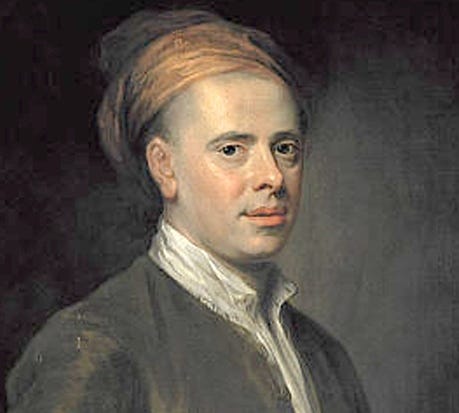
Ramsay ran the library for around fourteen years, but its legacy continued through several other owners before it was purchased by Alexander Kincaid, a printer and publisher who later passed it to his stepson, William Creech.
The building became known as Creech’s Land, and he remained there for forty-four years, rising to become the city’s chief publisher and most prominent bookseller.
In 1786, Creech met Robert Burns. That meeting led to the Edinburgh Editions of Burns’ poems, offering readers a first glimpse of works such as “Address to a Haggis,” “A Winter Night,” and a few now-famous spelling mistakes.
Creech also published his own writings. After serving on the jury at the trial of Deacon William Brodie, he produced a personal account of the case, which was on sale in his shop within days.
Indian Pete and the Penny Post
The Luckenbooths were a hive of innovation. In 1769, they became the base for Scotland’s first regular postal service, run by one of the city’s most remarkable characters.
Peter Williamson ran a Penny Post from his premises, giving Edinburgh residents a reliable way to send letters and small parcels for a single penny. Already well-known as ‘Indian Pete’ for dressing as a Native American, he had a dramatic past: kidnapped from Aberdeen as a child and transported to America, he survived years as an indentured servant before returning to Britain, where he challenged his abductors and supported himself through coffee houses, publishing and performances.
The Penny Post was eventually absorbed into the General Post Office. For three decades, however, it had operated from the Luckenbooths themselves.
Trade, print, communication, and spectacle all met here. The market had become indispensable, and its very success would soon seal its fate.
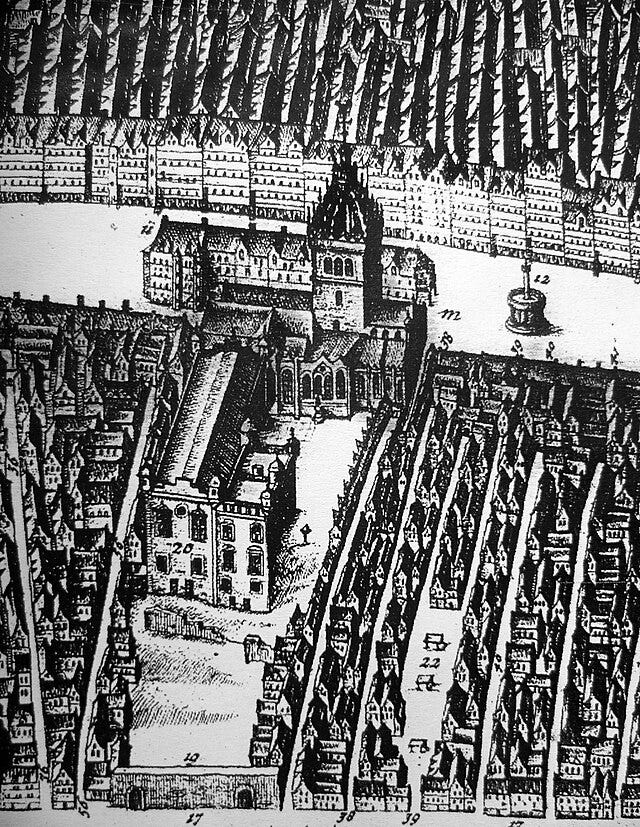
Old maps of Edinburgh’s Old Town show the Luckenbooths flush against the Old Tollbooth prison, a bottleneck in the bustling street.
Early in the 19th century, council planners decided to remove the shops and prison to ease congestion, allow vehicle access, and improve the city’s appearance.
The Luckenbooths had witnessed royal upheaval, reformation, and survived plague and fire. By 1817, they were gone, the merchants dispersing into nearby closes.
Traces of History
Further down the Mile is John Knox’s House, the oldest building on the street. Inside, you’ll find the only surviving physical remnants of the Luckenbooths.
Although most booths had stood outside the cathedral, smaller versions existed elsewhere along the High Street. The ground floor of John Knox’s House was one such example, safe from destruction. You can see the old shop fronts near the current bookshop and reception area, visible between windows and bookcases.
In the Canongate, the often-overlooked Museum of Edinburgh features a detailed scale model of the Royal Mile, showing the medieval layout of Old Town. It is just one of many exhibits offering a visual insight into the past of this incredible city.
Across from St Giles is ‘Luckenbooths,’ a restaurant that keeps the history alive. Its walls and menu are adorned with sketches of the old shops, and, in partnership with Old Town Chambers, it offers a curated range of local gifts in its lobby.
Edinburgh council ensured that the presence of these historic buildings would not be forgotten. Today, all that remains of the St Giles Luckenbooths are brass bricks set into the Royal Mile’s cobbles, tracing the outline of the stalls.
These brass setts form part of Edinburgh’s broader heritage landscape, alongside markers for the Netherbow Port, the old tollbooth, and even the last public hanging spot in the city. They invite passersby to imagine the stalls that once thrived there, glimpsed under the heavy footfall.
Here Indian Pete once stood, regaling people with tales of his colourful past. Perhaps your ancestor waited to speak to an apothecary about an ailment long gone, or wound through the crowd clutching their first copy of Burns, eager to read the verses that had everyone talking.
One of Mary Stuart’s royal servants may have purchased a brooch for her husband-to-be here. From 1440 to 1817, almost every resident of Edinburgh - rich, poor, or middling - would have walked these cobbles, making their own purchases.
Perhaps that’s enough to make us slow our pace through these streets, to carve out time early in the morning, before the tourists arrive, and imagine shopkeepers setting up for the day almost 600 years ago.
