




Standing on Leith walk with a microphone, it doesn’t take more than 30 minutes for a pattern to emerge. When asked how Leith has changed, long-term residents seem to bring up one specific word.
“It’s become more gentrified. The old industries are gone, the old character’s gone,” says Robert, who’s lived at the top of Easter Road for 73 years (and points out that means he’s not a Leither, by the way).
Elizabeth has lived in Leith for forty years and shares a similar view: “I suppose it’s been gentrified in areas, the more upmarket housing that’s been built, the shops that are here, just a different clientele.”
Speaking to more recent arrivals, we get straight to the word in question. Do they think Leith is gentrified?
“It will be [gentrified] at some point for sure. Not just yet, but in a couple of generations. Or one generation probably,” says Stefano, who has lived in Leith for just over a year.
Haleema and Amelia have lived at The Shore but “not for very long”:
“I’ve spoken to quite a lot of people who live in Leith and they’ve said that it’s very different to what it used to be, even like five years ago,” says one. “I think it started with the Michelin stars on the Shore, and then the trams, and AirBnBs,” adds the other.
Almost everyone we speak to agrees, Leith is undergoing a process of gentrification. But what does that mean? Does the data back it up? And how is life changing for residents and businesses? These questions are the makings of a PhD thesis, not an article. But we will do our best.
Over two long reads, we hope to unearth the reality of gentrification beneath these soundbytes – first for Leith residents, and then for business owners.
What actually is gentrification?
“One by one, many of the working class quarters of London have been invaded by the middle classes – upper and lower. Once this process of ‘gentrification’ starts in a district it goes on rapidly until all or most of the original working class occupiers are displaced and the whole social character of the district is changed.”
This was the first recorded use of the word ‘gentrification’. It reads like it was written in 2026, but it actually comes from a 1964 book London: Aspects of Change by sociologist Ruth Glass. Glass used the term to describe the trend of middle class couples moving into then working class Notting Hill and Islington. Their financial ability to renovate properties led to poorer families being priced out of the area.
More than fifty years later, gentrification has become a common talking point in cities around the UK; from Hackney in London and Glasgow’s West End to Salford in Greater Manchester and, of course, Leith.
The port town, absorbed into the City of Edinburgh just over a century ago, has gone from the grizzly setting of Trainspotting to the Sunday Times’ top neighbourhood in Scotland in 2020.
Both of those characterisations of the area are to some extent generalisations, though. Just as the term “gentrification” is a generalisation, which can’t fully describe the undeniably rapid change the neighbourhood has undergone.
What do Leithers think?
Lisa Clark was born in Leith in the 1960s, to working class parents, and has lived in Leith almost all of her life. In fact, the furthest she ever ventured away was to the top of the Mound while studying Divinity at university – even though her mother said she’d much rather Lisa became the manager of Woolworths at the foot of Leith Walk.
The Leith of Lisa’s childhood still very much felt like a working port. It was not as cosmopolitan as it is now, she says, but certainly more diverse than the rest of Edinburgh.
Lisa remembers car ownership was very low, but home ownership was high.
“My father didn’t ever earn much money and my mum was disabled so she couldn’t work, but they still could afford a two bedroom flat in Dalmeny street, and that wasn’t considered exceptional,” Lisa says. Among her schoolmates at Lorne Primary and Leith Academy, the vast majority, she says, lived in houses their parents owned.
Back then, Leith Walk was a more traditional high street where you could buy everything you needed, she recalls. This was when the remains of Leith train station - now occupied by the large Tesco - was still a brownfield site and a scary place to walk through alone as a teenage girl going to school.
The changes began in the 1990s, Lisa reckons, when the butchers, bakers and grocers gave way to supermarket chains. In their place, Leith Walk has been gradually populated by cafes, restaurants and artisan bakeries, although some of the older businesses stand strong. Storries Home Bakery, the Vacuum repairs shop, and a couple of laundrettes have been in operation for around half a century now.
Many of these changes echo what has happened across the UK over the same period.
“A lot of this is much broader cultural stuff,” says Lisa. “Even when I was at university, you didn’t really get coffee shops… it was just an entirely different world.”
Housing is key
One way that Leith has changed particularly stands out for Lisa. “Housing is the key pivot here that maybe shifts us up a couple of demographics,” she says.
Her observation echoes a conclusion of Ruth Glass’s research back in 1964 – that a key marker of gentrification is increasing housing costs.
The theory is that, to wealthy households, the neighbourhood is both cheap and vibrant, and therefore attractive. To those already living there it is not cheap; it’s affordable. But prices rise as the market adjusts to greater demand from buyers or renters willing to pay more than their predecessors. Rents and house prices in the area go from cheap to middling for the wealthy, and from affordable to unaffordable for those on low incomes.
This chimes with the experience of Lisa, who currently rents a two bedroom flat. Despite having grown up in a house her working class parents owned, gone to university, and earned more than her parents did, she cannot afford to buy a flat in Leith.
“There are houses on my stair that are on sale at the moment… costing three hundred thousand. That just wouldn’t have cost that [much], which is why people like my parents were able to buy that,” she says.
Leith-raised musician Bee Asha told us a similar story. Asha – who this month launched What a Beautiful Place to Fall Over, a music, documentary, art and event project exploring the impact of gentrification in Leith – was lucky enough to be able to buy in her home neighbourhood, but only after 14 months of bidding on homes and thanks to the generosity of the seller.
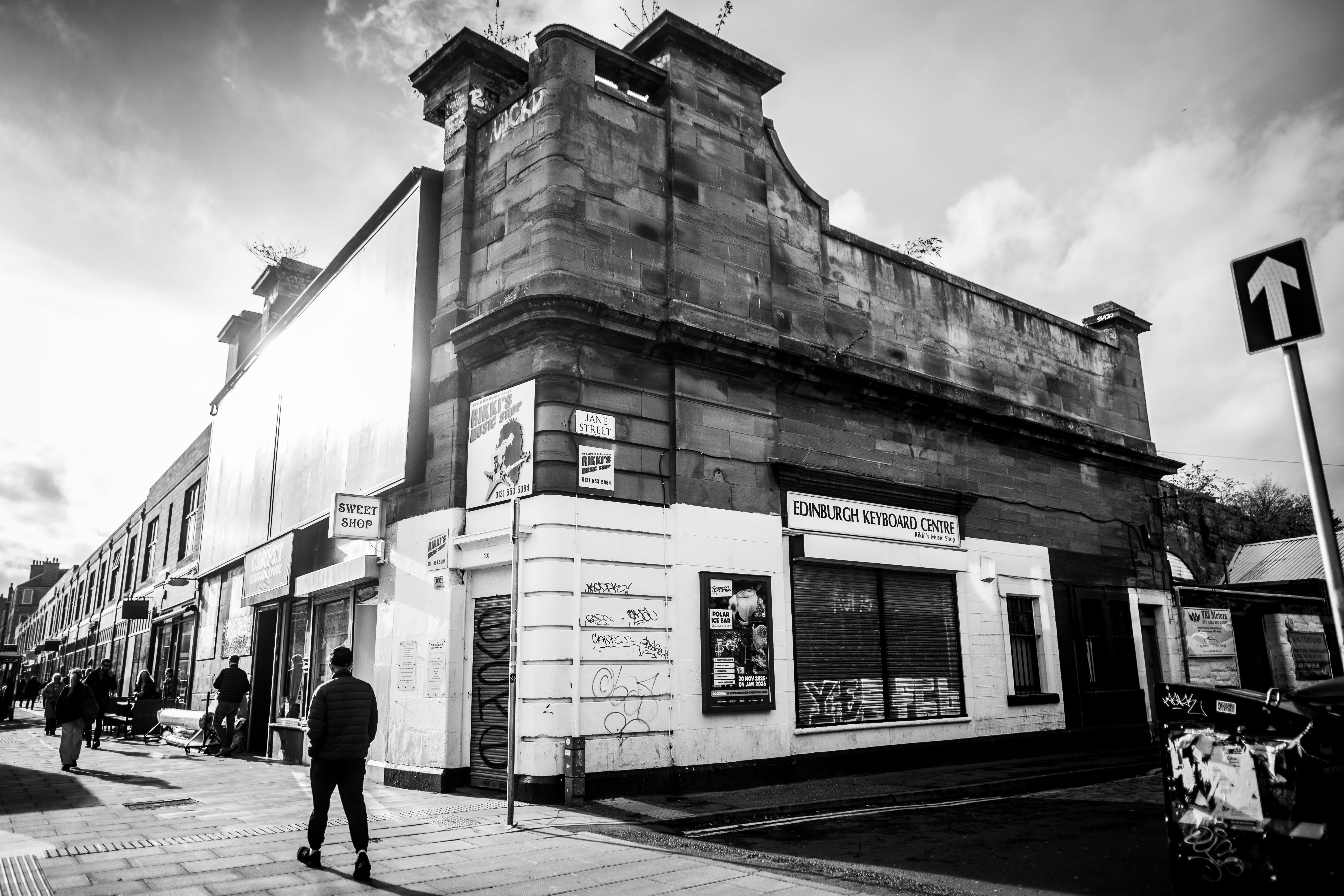
Asha was outbid by more than £40,000 for the Leith flat she now lives in, but her offer was accepted after she wrote a letter to the seller explaining her connection to Leith and her struggles to find an affordable home. The seller passed away shortly after the sale. “I think because he… didn’t need the extra money and he thought, ‘I may as well give back to my community,’” she says.
Demand for all kinds of housing in Leith has increased, says Susan Rae, a Scottish Greens councillor for Leith Walk ward and social housing tenant.“This is the most requested area for social housing, everyone wants to be here,” she says.
Councillor Rae adds that her son, now trying to buy a home in Edinburgh, won’t look anywhere but Leith because of the abundance of shops, cafes, restaurants and bars. That demand is undoubtedly going to drive up prices in the private sector.
What does the data tell us?
