


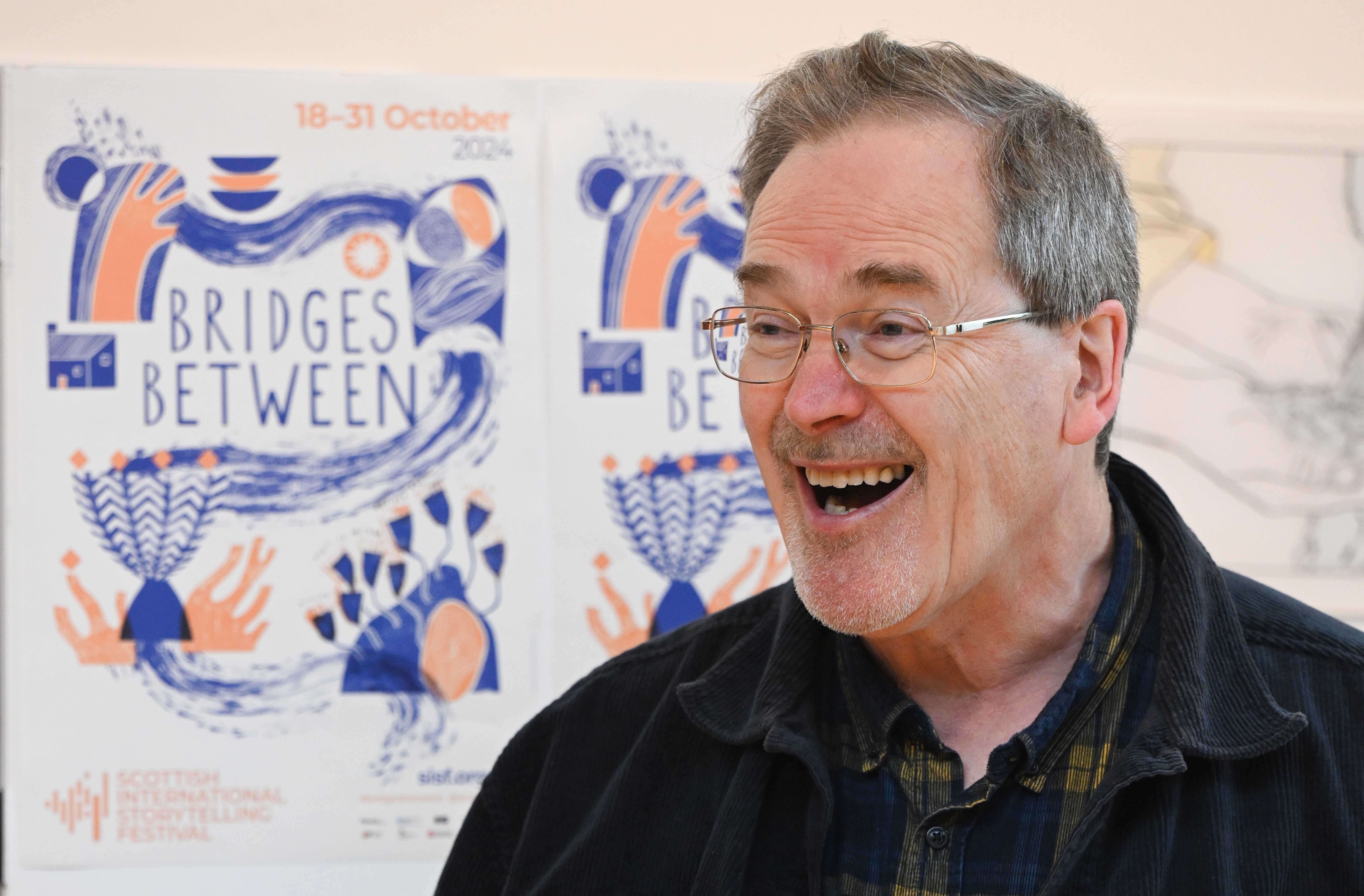
“Both those things - the oral storytelling thing and the development of the National Theatre - came out of that key period of struggle in the 1980s. It’s lovely to me that at this point I’m moving on from being involved.
“I won’t have a formal role in any of them, but I feel they’re all in a good place. There is so much possibility for the future. I’d love to be a small part of that in some way, but that’s not the thing. It’s interesting to reflect on where it came from.”
It is a rare thing in the Scottish arts scene to find a set of fingerprints as pervasive, yet discreet, as those of Dr Donald Smith, writes Will Quinn.
To the casual observer, or perhaps the regular attendee of the Scottish International Storytelling Festival (SISF), Smith is the genial, knowledgeable figurehead who has steered the event for 36 years. He is the man who helped take a handful of events in pubs and transformed them into a flagship festival with audiences topping 40,000.
But as he steps down as director following the 2025 festival - themed, fittingly, Lights of the North - it is worth looking at the machinery beneath the surface.
Smith’s career has not merely been about booking acts; it has been an exercise in cultural engineering. From the establishment of the Scottish Storytelling Centre to his less-publicised but pivotal role in the creation of the National Theatre of Scotland (NTS), Smith has spent four decades building the structures that allow Scottish voices to be heard.
The School of Scottish Studies
To understand the trajectory of Smith’s career, you have to look at the choices he made at its very beginning. In 1979 - a year defined politically by the disappointment of the failed devolution referendum - Smith made a choice that would define his future.
“I went in 1979 to the School of Scottish Studies, which was a definite big decision to step away from other areas of academics,” Smith recalls. “That was to have a huge ongoing influence.”
At a time when Scottish culture was often marginalised or treated as kitsch, Smith chose to immerse himself in the serious study of its traditions. It was an intellectual pivot that placed him in the orbit of Hamish Henderson and the great collectors, grounding his future practice not in nostalgia, but scholarship and a deep respect for the source material.
The Storm and Drag
Armed with a PhD but facing a bleak economic landscape, Smith’s entry into the professional arts world was less than glamorous. In 1982, he arrived at the Netherbow Arts Centre on Edinburgh’s Royal Mile. The non-descript venue itself had only recently replaced the Moray-Knox Church, a Victorian neo-Gothic structure demolished in the 1960s, leaving something of a scar on the High Street.
“The 80s were a storm and a drag,” Smith reflects. “Looking back, things have been difficult since in many ways, but I think the sheer desperation of working on just nothing was... I’ve never experienced anything like it again. Yet there was that determination to make something out of nothing.”
His role? Not director, not yet.
“First, as a stage manager here at The Netherbow, which was in a fairly difficult state,” he laughs. “Nae cash, nae staff, nae whatever! And yet, this fantastic little theatre.”
He was, in his own words, “the swiftly rising captain of a sinking ship.” But for a man with big ideas, it was a laboratory. “Whatever my ideas - and I certainly felt there were distinctive energies in Scottish culture that I wanted to tap into - the practical thing was that there was no money in the arts. There were precious few opportunities for talented people to get a break.”
Necessity proved the mother of invention. The Netherbow became a sanctuary for the neglected. Smith recalls being particularly “horrified” by the standard of children’s theatre available at the time - ”it was just so low grade” - and opening the space to better work. It became a hub for new writing, for actors, and for directors.
The Three Hits: 1979, 1986, 1989
For Smith, the journey from that listing ship to the establishment of a national institution is defined by what he calls “three hits on the storytelling centre journey” - three specific moments in time where the potential of the art form revealed itself.
