


The symbolism of darkness is terribly easy to grasp, understood before humans can even speak. Depression, death, evil, and the terrifying unknown. But darkness possesses irony, too. Light, understanding, revelation, and profound clarity, writes Jonny Muir.
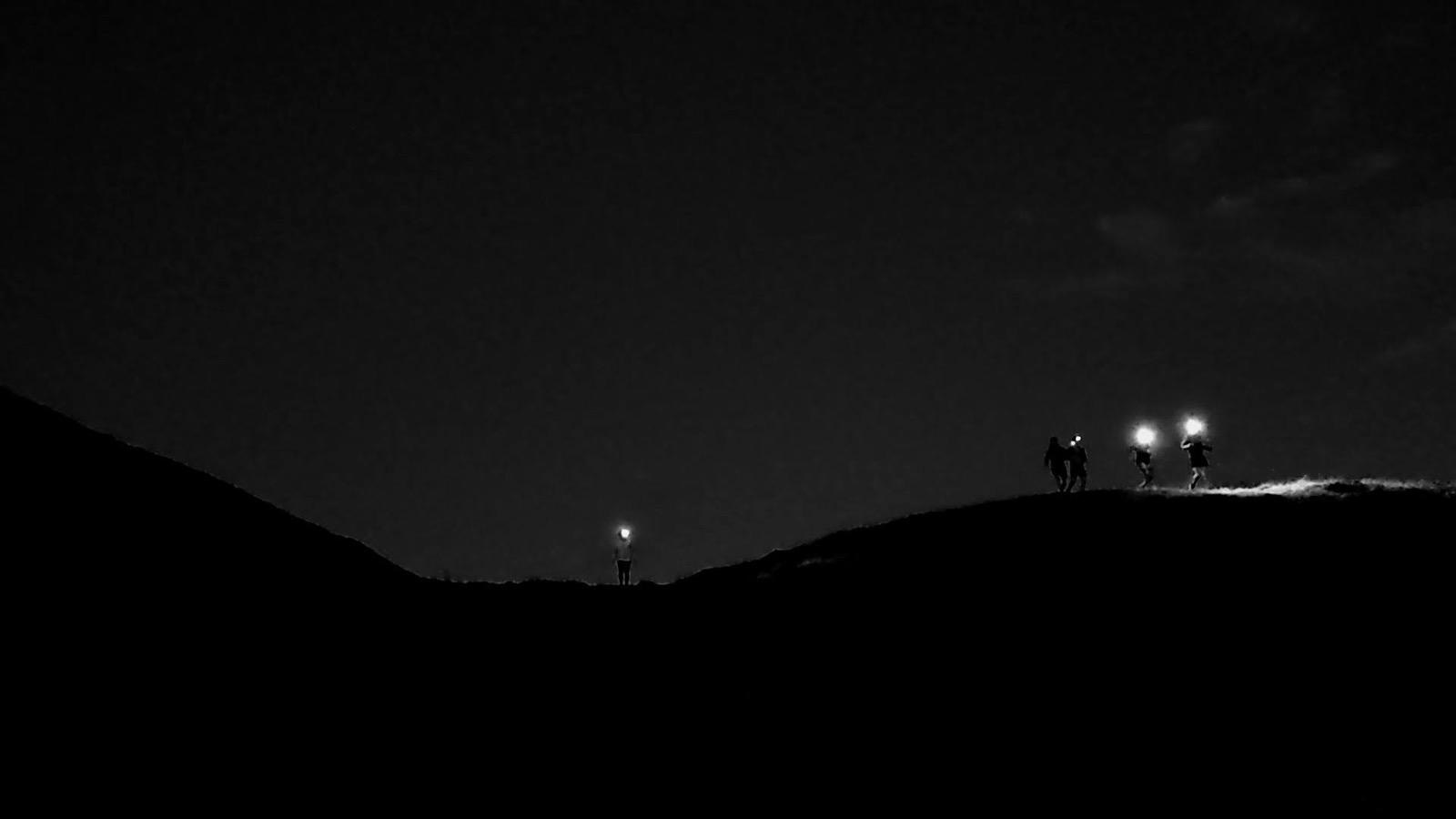
Edinburgh is not a place of literal darkness: at night, the city cascades a yellow-white haze into the sky, daring to outdo the stars. Darkness must be sought. Spin to the south and you will see the place it reigns: the Pentlands, Edinburgh’s hills, grey, hulking silhouettes, millions of years old. Look closer still. Are those pinpricks of light, hundreds of metres above where you stand, moving imperceptibly but moving? And there they are: those who embrace darkness in pursuit of light.
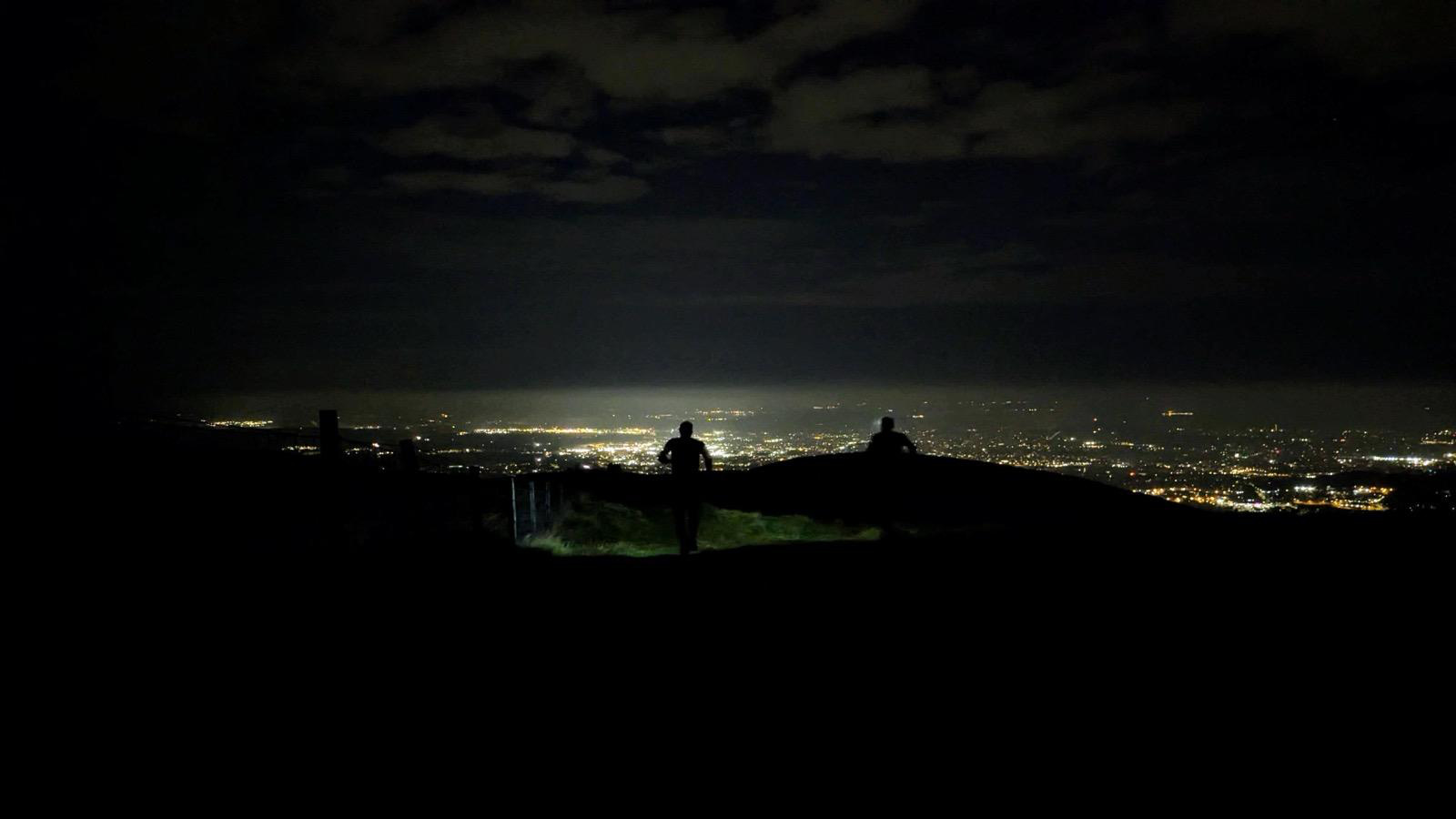
We move from light into dark: from the garish glow of a supermarket and the street lamps of Swanston to the rising paths of the Pentlands, revelling in juxtaposition, revelling in leaving the city behind. We might identify as ‘runners’, but running is not the singular verb to describe the action this night. Yes, we run, but we walk and talk and think and feel, too.
As the path narrows, we move in single file, vision reduced to a bouncing beam of comforting torchlight, focusing on the next moment, the next step. Higher still, climbing beneath the crags of Caerketton, the wind sighs and wet grass sparkles like tinsel. We pause at the saddle, huddled, a little coven, and switch off lights, searching fruitlessly for the Beaver Moon among the clouds, but instead watch the sprinkling fireworks on what is Bonfire Night.
We continue along the ridge, leaning into the wind, up to the summit of Allermuir, and from this high point the dun canvas of the Pentlands is laid out before us. There they are, starkly breaking the gloom: a pinprick on neighbouring Capelaw, more lights lower down on Allermuir, a pair of torches on the military road to Castlelaw. Far below, Edinburgh, seen through watering eyes, is a swollen, choked mass of manmade light, only to be sliced open by the inky water of the Firth. For the hundredth – or maybe two-hundredth – time, I marvel: a city of some half-a-million people lies at my feet – and up here, scarcely four miles from Princes Street, it is just me.
There is nothing superhuman about us. We are young, old and somewhere in the middle; we are men and women, we are fit and less fit, we have jobs and children, we are messy, inconsistent and flawed. We talk about the minutiae of life, the things you might discuss with a friend in a coffee shop in Bruntsfield: how to negotiate Christmas as a divorced parent, the excitement of expecting a second child, the ailing health of a sick relative. But we are bonded by a common understanding of the irony of going to the dark Pentlands: we know that within the discomfort of dark, cold, wild hills is a perverse comfort. Tell me why you are here, I had implored the group that night, and in the days that followed, they offered words like confessionals – and it is not for me to paraphrase those words.
‘Running in the Pentlands during the day already feels like a heady escape from the demands of parenting and work, but at night-time it feels more so, perhaps because it’s more unusual or unexpected. I feel like none of the normal interruptions and concerns of daily life can touch me there. Being in the Pentlands at night feels like the closest thing I do as an adult to ‘play’.’
‘I was fresh out of a long-term relationship and was dealing with the grief of that. Darkness reflected how I was feeling, but also made me less self-conscious about my breathing and what I looked like. In time, darkness became a shield, a protective cloak.’
‘The darkness envelopes you. Being able to see the stars, meteors and satellites floating about in the sky above you makes you feel smaller and more insignificant, which really helps to put our life and first world problems into perspective. At the same time, you feel invincible – this sense of empowerment.’
‘Everything else, both physically and mentally, seems to fall away, and the pure simplicity of repetitive movement, with only the beam of light to hold onto feels meditative and peaceful. The space between you and the other is bigger, but somehow the sense of connection when you see the lights ahead and behind is enhanced. We are separate but part of a whole. Running at night always feels like a microadventure. I feel strong and resilient afterwards, and able to tackle the rest of life.’
‘The veil of dark is intriguing. I love the feeling of the transient sphere of light around you, always conscious of the boundary where light meets dark, and a meditative focus on foot placement that allows the brain to settle. If you step out of the sphere, separating yourself from the pack for a moment, without light, you experience the other side. A spectator, detached and adrift, under a huge expanse of sky.’
‘The hills are a place for beauty, space, peace and reflection. They are a sanctuary. They don’t judge you either and are there when you need them. You know where you stand with a hill; they don’t ask for anything in return. I suppose a hill is like a spiritual god, with blood, sweat and tears the offering.’
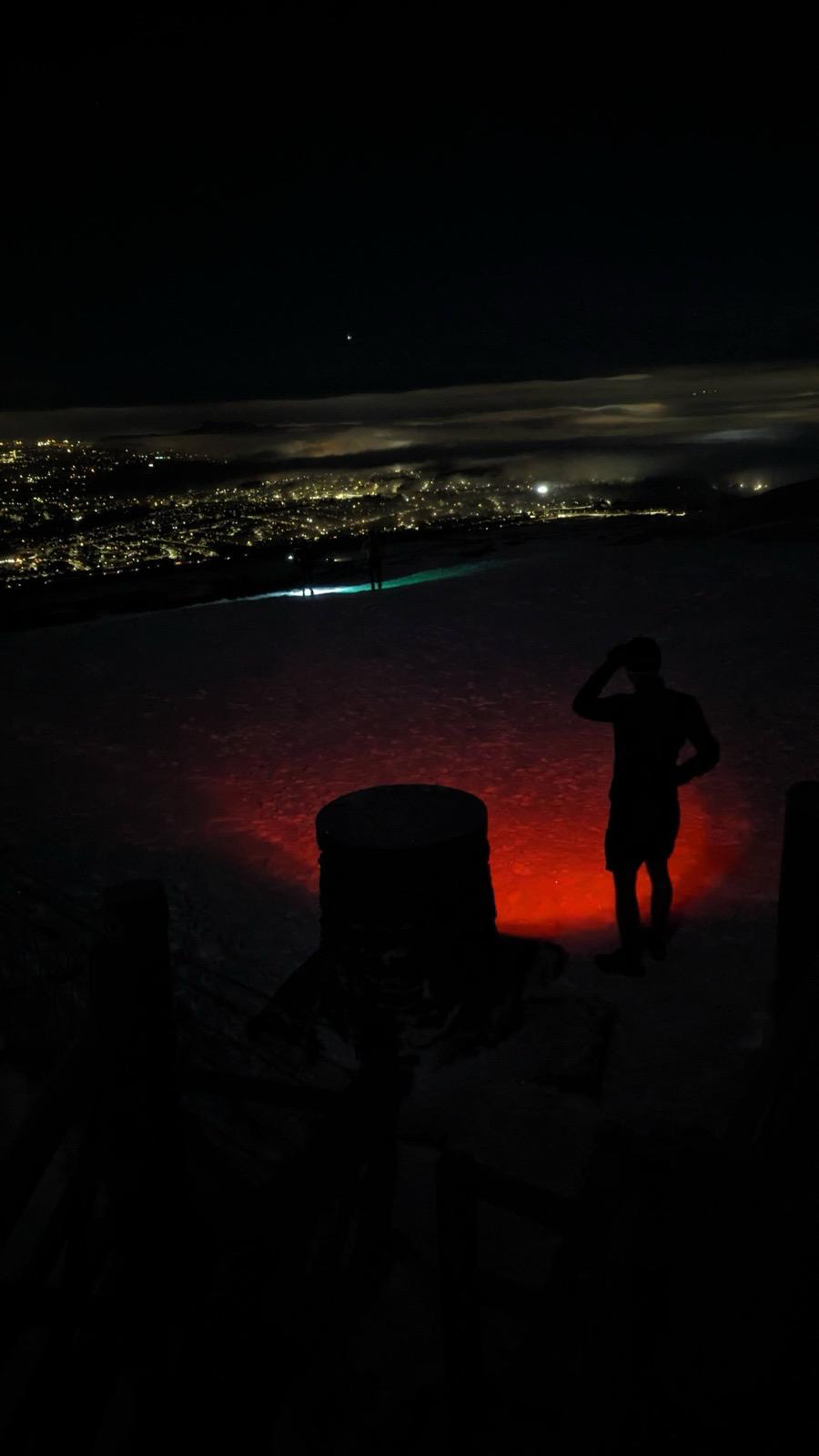
I think back to a February night some years ago – a fragment of blinding clarity amid the fug of memory. The slopes of the Pentlands were draped in snow. On this February night, we descended the rough bog and tussock of Hare Hill, while grey, swelling outlines seemed shuffled about in the confusion of darkness. We do not see the hills – not ‘really’ anyway – but we are among them. We felt them beneath our feet, on our hands as we reached out to rock and heather. We were a part of them, and they were a part of us.
We could not have been more present.
I reached the summit of Capelaw first, then turned to see three circles of yellow pierce the darkness. I imagined then someone looking up from all the way down there, on a bus, on the bypass, on a city street, spotting our beams, wondering who we are. I tell you what we were. We were untouchable. As we descended Caerketton, above a sleeping Edinburgh, we feel like the first people in the world.
