

Have you ever wondered what difference high-speed rail could make to life in Edinburgh? Then wonder no more, because Corey Boyle has found out for you.
As many of you will know having enjoyed his writing in the past, Corey is an award-winning engineer with a special interest in active travel and the potential of public transport.
You can enjoy his long read below, but first your usual news update and cultural highlights.

Your Edinburgh Briefing
FRINGE SURGE: A record number of productions are heading to the Fringe this summer despite fears that soaring costs will see artists being priced out of the Edinburgh in August. With more than two months to go before the official programme launch, more than 2000 shows have been registered for the first time, an increase of 16% on last year. You can get a flavour of some of the weird and wonderful offerings here.
JOIN THE Q: Leah Byrne, Matthew Goode and the stars of Department Q will return to Edinburgh in July for filming on the second series of the hit Netflix crime drama. Location filming in and around Edinburgh is expected to take five months. Argyle House, the Brutalist office block facing demolition, is expected to feature again as the central Edinburgh police station.
BOY RACER: A 15-year-old boy has been charged after police chased a stolen car he was driving down Princes Street. The boy ran off after the short chase at around 4am on Tuesday but was later caught by officers.
HOME AT LAST: The city’s biggest grassroots football club has won its seven-year battle for a permanent home for its 1000-plus players. The city council has agreed in principle to let Edinburgh South Community Football Club build an all-weather pitch and changing block on land at Inch Park which is being used to store council equipment.
CULTURE TOWN: At stake is £3m to spend on staging six months of cultural events - and all the prestige and hype that would come with being the UK Town of Culture 2028. Dalkeith, Penicuik and North Berwick have all thrown their hat in the ring. Other Lothian towns may follow. Not to be outdone, Leith has made its own bid. Ok, it’s not technically town (at least since its 1920 merger with Edinburgh), but it is very cool. Its bid also has the backing of such luminaries as Irvine Welsh and institutions including Hibs FC.
Your Pick of the (Cultural) Pops
Greetings, Pop Pickers! Welcome back to the chart. As we officially cross into April, I hope you have all survived the annual theft of that precious hour of sleep when the clocks went forward. But look on the bright side: the evenings are stretching out, and we have a massive shake-up in the list to match the new season, writes Will Quinn.
This week’s chart is quite the assortment box. We’ve got B-movie Gilbert & Sullivan, a healthy dose of pregnant existential dread, the RSC swapping the Bard for razor-sharp 1920s comedy, and a neo-classical hall stuffed with incredible emerging art that you can actually buy. As the final applause fades for a few of our recent one-night gigs and short runs, a whole host of fresh entries has arrived to fill the void.
Let’s count them down...
Remaining in the Honourable Mentions: One Day (Royal Lyceum Theatre, until Sunday) Still holding onto an honourable mention as it enters its final weekend is the Lyceum’s mammoth new musical. Interestingly, I’ve recently revised my opinion of the Netflix adaptation. After getting beyond a rather lacklustre opening episode, I’m now appreciating its better-paced storytelling and the more palpable chemistry between the leads. It also benefits from a cracking era-appropriate soundtrack, which has really crystallised my feelings on this new stage production’s score: it is such a missed opportunity not to have tailored the music to fit the years, tracing the glorious 80s, right through Brit-Pop, and into the Post-Punk revival.
But enough about the missed musical opportunities of yesteryear—let’s get into the shows that are actually hitting the right notes this week. Kicking off the official countdown...
New in at Number 5 is... EUSOG: Ruddigore (Bedlam Theatre, until Saturday). Since first catching an EUSOG production in the midst of a global stramash over their casting of a woman in Jesus Christ Superstar back in 2023, this plucky bunch of comic opera and musical theatre enthusiasts has consistently impressed with the quality and ambition of their work. Now, they return with a B-Movie horror take on Gilbert & Sullivan’s Ruddigore (performing G&S being the originating raison d’être for the Edinburgh University Savoy Opera Group when they were founded back in 1961). Their take on G&S’s most haunted work will doubtless be a memorable affair. The proof of the pudding will be in the eating, of course, but I expect this to be a highly fun and very melodic night at the theatre.
Staying firm at Number 4 is... Footloose (Edinburgh Music Theatre, until Saturday). Holding steady this week, the Edinburgh Music Theatre team are now officially cutting loose. Let’s be honest, the stage adaptation of this 80s classic isn’t going to win a Pulitzer for deep dramatic nuance, but EMT consistently punches above its weight in the unpaid tier of the city’s theatre scene. Between the unapologetic cheese factor and a soundtrack loaded with absolute earworms, they know exactly how to deliver a high-energy, crowd-pleasing spectacle. Grab your tickets before the run ends this weekend — I’m heading into review the show when it opens tomorrow — check in on theQR.co.uk to see whether I ultimately agree with my own recommendation!
Staying at Number 3 is... The Capital Theatres Double Bill. Remaining firmly at Number 3 is our two-for-one entry over at Capital Theatres, as both of these heavyweight visiting productions officially open their doors this week.
At the Festival Theatre, the Royal Shakespeare Company is proving there is life beyond the Bard with The Constant Wife (until Saturday). Featuring Kara Tointon leading the cast and a fresh score by Jamie Cullum, it’s a potent, stylish mix that breathes vibrant new life into Somerset Maugham’s deliciously cynical, feminist comedy.
Meanwhile, if you want something decidedly darker, duck into The Studio for Northern Broadsides’ Crime and Punishment (until Saturday). Boiling Dostoyevsky’s sweeping, psychological thriller down to a cast of just three actors is a spectacularly daring feat. With director Laurie Sansom at the helm and Connor Curren starring as the murderous Raskolnikov, this promises to be a gripping, claustrophobic masterclass in tension.
New in at Number 2 is... GUSH (Traverse Theatre, April 10th – 25th). This marks the professional debut of writer Jess Brodie and follows Ally, a woman in the final days of her pregnancy who, despite all the antenatal classes and caffeine bans, still feels something is entirely off. Determined to take control of her life before the baby arrives, the piece promises a funny and frank exploration of self-identity, sexuality, and the barriers preventing women from owning their desires. Directed by one of Scotland’s brightest up-and-coming talents, Becky Hope-Palmer, and benefiting from a cracking line-up on stage and behind the scenes, GUSH is a real testament to the power of publicly funded writing initiatives, having begun as a response to a Playwright’s studio call-out, before being picked up by the Traverse’s First Looks programme last year. GUSH’s arrival on the professional stage shows the Traverse is putting its money where its new-writing mouth is.
And storming straight in at Number 1 is... RSA New Contemporaries 2026 (Royal Scottish Academy, until April 22nd).
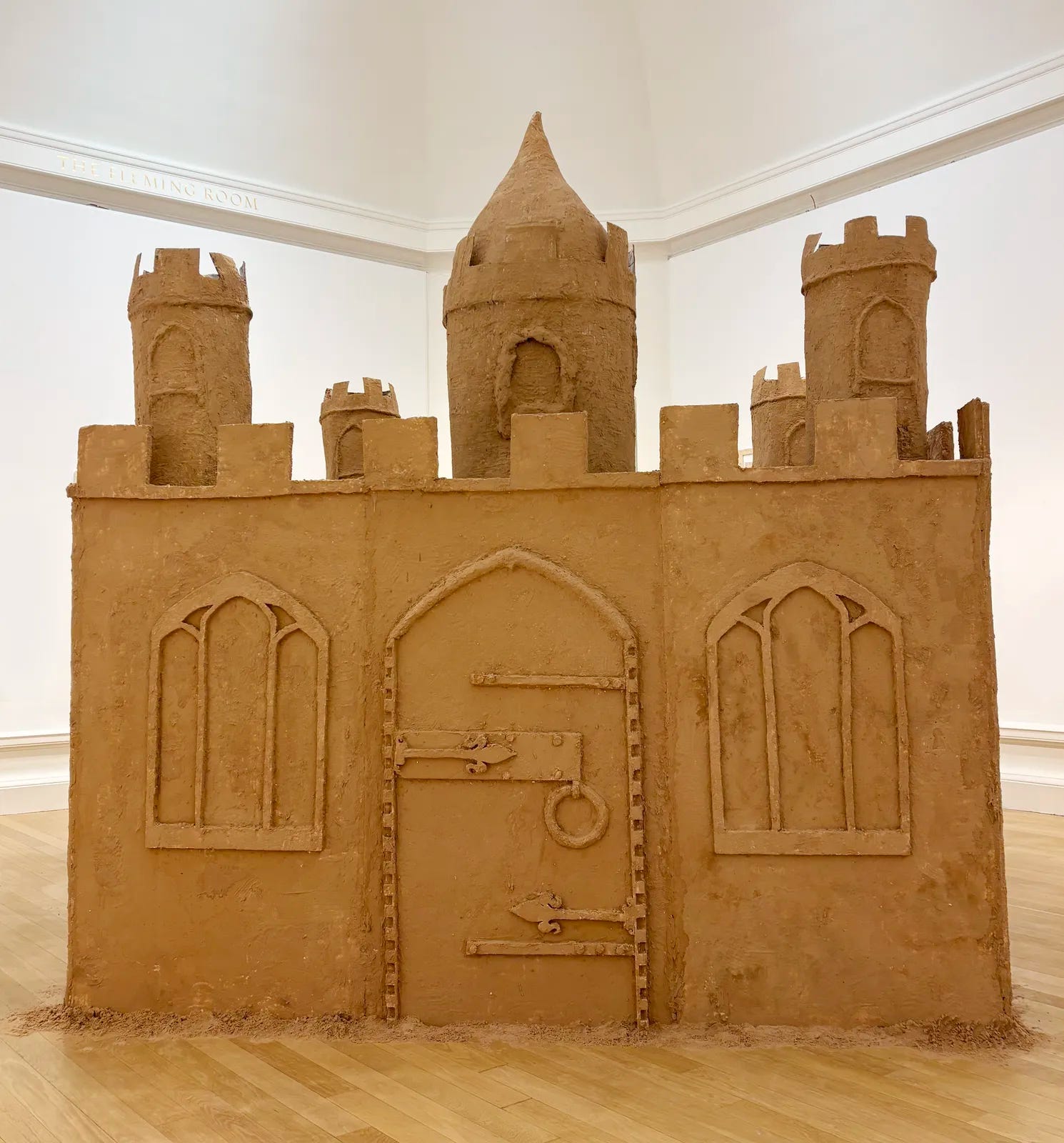
Taking the top spot this week is the RSA’s annual celebration of emerging artists, returning to the neo-classical halls of the society’s home on Princes Street. I’ve been in for a look, and I absolutely guarantee there is something in there for everyone. Whether it’s an arresting encounter with a most impressive sandcastle, standing mesmerised before an arrangement of wandering figures painted from behind, or wandering the fully imagined halls of a could-be palace of the arts in Glasgow, it certainly offered plenty for me. There’s so much more on and between the walls that either wasn’t for me, or which simply defies description—and the brilliant thing is, if you really, really like anything you see, you can buy it! This isn’t the National Gallery; these pieces are made by living, breathing artists out to earn their rent.
And that’s your Top 5! Get out there, book some tickets, and tell them who sent you. As always, I’d love to hear whether we put you onto a good thing, or if you think we sent you out for a night to forget!
The missing link in Edinburgh’s rail revolution
Corey Boyle on the potential of high-speed rail and the missed opportunity for Scotland’s Capital
You live in an EH postcode. You have an 11am meeting in Central London. And you decide, calmly and casually, to travel down that morning.
No airport security. No 5am taxi. No overpriced hotel the night before because London room prices are absurd, even by our own absurd Edinburgh standards. Even better, you sleep in your own bed.
At 8:15am you board a shiny new high-speed train at Edinburgh Waverley. Reaching speeds of around 190 mph (300 km/h), just over two hours later you step off in London after completing the roughly 332 miles (534 km) journey. Spacious seats, coffee, Wi-Fi, and a fraction of the flight’s emissions. You make your meeting comfortably. There is even time for a (thankfully) expensed lunch. By late afternoon you are back in Scotland’s capital before the close of business on the same working day.
This is not fantasy for Lyon to Paris or Seville to Madrid. It is entirely normal across Europe and Asia. But between Edinburgh and London, it remains hypothetical and fanciful.
Journey times today hover around four and a half hours. Implementing a truly high-speed railway (HSR) would halve journeys to something close to two hours, and the relationship between the UK’s two capitals would change overnight. Day trips for business and leisure would become routine. Day trips would become routine, reshaping where businesses base staff and how investors see distance. Edinburgh would no longer feel peripheral; it would feel local to the rest of the UK.
