


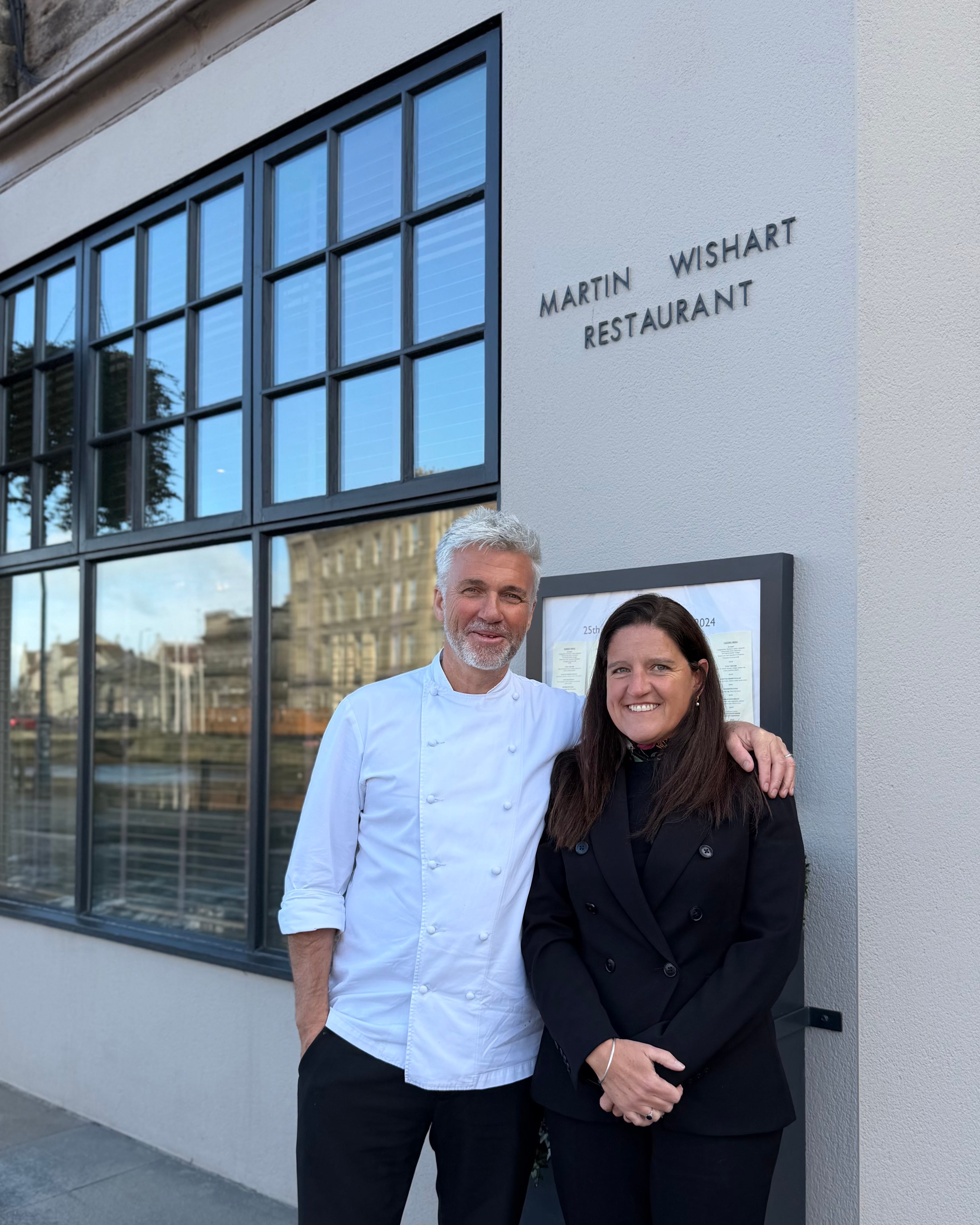
Edinburgh gourmands owe a debt of gratitude to a former Broughton High guidance teacher, Andrew Young, who was responsible for setting a 15-year-old who liked cooking on a culinary trajectory which ultimately revolutionised the city’s fine dining scene.
The city currently has seven one Michelin-starred restaurants, with a total of 36 recommended in the foodie bible. Before Martin Wishart gained his Michelin award in Leith, 25 years ago, there had never been a single starred restaurant in the Capital and scant few guide mentions.
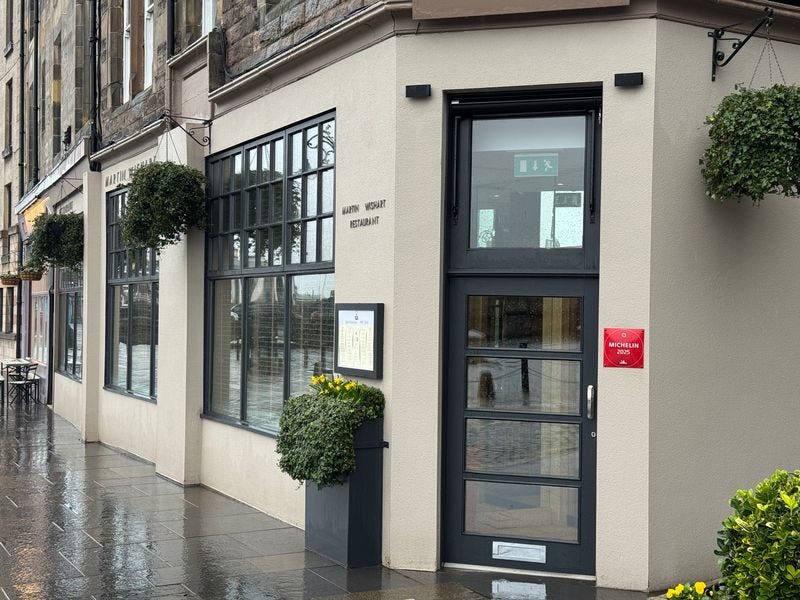
Today, in Leith alone, there are multiple Michelin one-starred and recommended eateries to choose from, but when pioneering Restaurant Martin Wishart opened on The Shore in 1999 the area was just beginning its gentrification journey.
Martin, who suffered from childhood epilepsy, explained: “I worked hard at school, but I found it difficult to focus; I was just put into a class, and that was that. There was no talk of university.” At the age of 15, when he told Mr Young that he enjoyed cooking with his mother, a culinary Youth Training Scheme was suggested instead of the planned career in carpentry. Woodworking’s loss has been hospitality’s gain.
Around a decade ago his old teacher came to dine. He said: “I went out to say hello to him. I was blown away by the fact that I was speaking with him, because the last time I had seen him, I was 15, and at that age, I really didn’t know what I was doing. It was really lovely to see him again, and he was smiling from ear to ear, which was nice.”
There’s further reason to be grateful for his career choice as well as delighting our taste buds. A renowned fine-dining scene is good for our economy, as we reported last year.
Success through partnership
The biggest influence in his career and life is his wife and front-of-house business partner Cecile, who he credits as being a major part of the restaurant’s success. They have been married for 23 years. “When I left the Balmoral, she was working there. She left a month afterwards to join me in opening the restaurant. So much of our success is down to her; she’s just superb at what she does with guests, her friendliness, her professionalism, and her support as well. From day one, we’ve enjoyed the highs and the lows together.”
They first met when working at John Burton Race’s L’Ortolan in Reading. The couple clicked. Cecile was a hospitality student at Toulouse University, born in Mexico to French parents. The pair run their restaurant together and have three children: Clara, 21, Amy,18, and Jack, the youngest, 11.
Martin is not sure where his culinary talents originated; he grew up in Blackhall with his two brothers and didn’t have a foodie upbringing, his father George was a sales rep for Polydor records, and his mum Georgia worked in a bank. “I liked cooking at home, but it was very simple stuff; I was inspired by Keith Floyd on television.”
From the start he thrived in the structure of a professional kitchen. “Once you get into a kitchen, there’s so much that you can learn. I was just curious, and it’s just something I fell in love with, really.”
Campervan adventure in gastronomy
After a spell at Cameron House, Martin decided he seriously wanted to excel in his chosen career and headed to France to undertake several stagiaires (work experience) in Michelin-rated establishments. “I just felt that the best kitchens were in France. I was intrigued and wanted to test myself.”
He drove his VW campervan to Paris to attempt to get work in Michelin-starred kitchens. He wasn’t entirely successful, parking his van outside a royal palace which meant he was swiftly moved on. Burgundy was his next stop, to work at Marc Meneau’s restaurant in Vézelay.
When he ran out of money, he caught the ferry back to Portsmouth and saw an advertisement for Nick Nairn’s Braeval near Aberfoyle. “I phoned Nick and explained where I had been working and told him I was keen to come back home. He asked how soon I could get here for an interview, so I drove up the next morning and got the job.”
From this point on, his focus turned to owning his own restaurant, rather than chasing accolades and awards. His appetite for learning from the best remained strong and the next five years were spent working at some of the world’s finest restaurants: Le Gavroche, Restaurant Marco Pierre White and L’Ortolan.
It was Marco Pierre White who suggested that Martin approach Rocco Forte, who was looking for a head chef to open their restaurant at The Balmoral. “I got the job opening Hadrian’s, but it was a strategic move. I was very open with them about what I wanted to do. I wanted to look for my own place and find a network of suppliers.” Opening Hadrian’s at the Balmoral was his first head chef role.
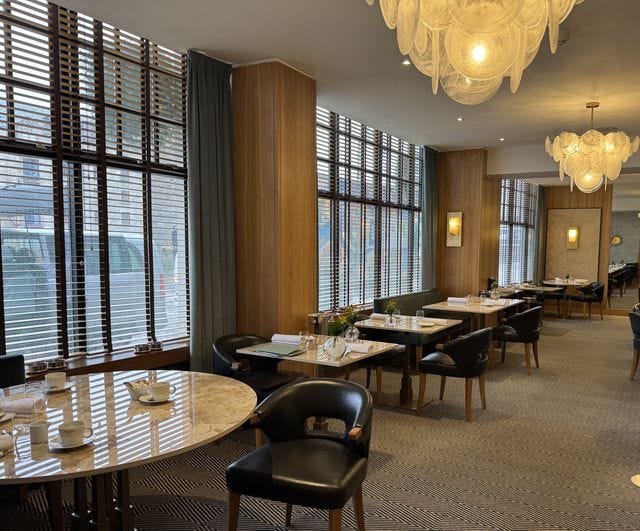
The hotel’s vegetable supplier gave him the nod about a potential venue in Leith, Silvio’s. The owner, Silvio Praino, was considering selling, and although they had never met before, Wishart hopped on his bike early one morning to chat. He points out of the window. “I put my bike up against the lamp post here and walked in.” He fell in love instantly with the place, he added. “I still see Silvio once every two or three weeks. We have coffee together.”
Heart, soul and money on the line
The reality of what drew him to Leith’s Shore was simple: cost, plus the waterfront location, but he added: “I walked in, and there was an instant connection. The kitchen was tiny, but then and there, I knew I had found the perfect place.”
The restaurant opened its doors in 1999, on a shoestring budget of £9000 with the help of family and friends. “I tiled the kitchen and painted the walls myself.” The marketing budget consisted of taping a handwritten A4 piece of paper in the window. “It’s just so nerve-wracking. I had put my heart, my soul and my money on the line.”
On the restaurant’s opening night, no one came; the second night, just two diners. Thankfully, word quickly spread. Reservations really took off a few months later when Albert Roux visited. “I worked with the Roux brothers in Amsterdam. I told him that I was going to leave to open my own restaurant in Edinburgh. After a few choice words, Albert said, ‘Okay, Martin, when you do, let me know, I’ll come and visit you.’ Albert was good to his word. He told the assembled journalists that the restaurant reminded him of Pierre Koffman’s La Tante Claire in Chelsea.”
In 2001, he won a Michelin star. He recalled: “I think it was a Friday, a customer called the restaurant in the morning to congratulate me on winning a Michelin Star. We had a busy lunch service, so I just went back into the kitchen, told the guys and then phoned Cecile. We had a glass of champagne later at night.” Having worked in 2 and 3-star establishments over the years, he understands the value, importance and pressures that Michelin recognition brings.
As the first restaurant in Edinburgh to make the guide, bookings soared, up to a six-month waiting list. Today, Leith is known as being a foodie destination, and he approves. “It’s great, because it puts a focus on the area, on Leith, and Edinburgh, which brings people down, rather than being all on your own.”
Another career highlight was winning a Michelin star for his second venture, Martin Wishart at Loch Lomond Cameron House. He says, “I was just delighted to be able to open at Cameron House, somewhere I’d worked before. It was completely different from what I was doing in Leith. It was in a hotel. It was on the other side of Scotland. We took some of my chefs from my kitchen in Leith, and we just really focused on the food. And, in the third year, we got the star.”
Sadly, a major fire closed the hotel in 2017 and remained closed for some time. The star was lost, through no fault of his.
No celebrity distractions for Martin
Martin has always shunned the celebrity limelight, preferring to concentrate on creating sublime dishes. “I was asked to go on MasterChef when it first started. I’d had a little taste of that stuff, but I didn’t like it. I didn’t need to fly down to London to spend all day going over the same thing. I just wanted to stay away from all the distraction. I like what I’m doing, cooking.”
Looking back over his 25-year Michelin-starred career, he puts his success and longevity down to hard work, quality and consistency, and crucially, keeping his ideas up to date. Many believe he is worthy of a second star, and he recalls an inspector asking him if he wanted two stars. His response to the question was “For me personally, yes, but for the business, I’m not entirely sure.”
He explains his reasoning. “It puts you up on a different level in your industry, but business-wise, you’ve got to maintain that standard. It means higher overheads, and that means having to charge more. I’m not so sure we’d still be open if we’d won two stars. I wouldn’t want us to obtain two stars and lose it again, that I would see as a fail.”
I ask him whether he’s seen pots flying across any of the top kitchens in which he cut his teeth? He pauses for a moment, considers carefully, and then replies: “It’s kitchens and restaurants, things happen. It’s not a job, it’s a lifestyle, it’s everything. These really good chefs and restaurants are high-pressure environments, but things have changed. You have to be able to manage your own stress. Running a business is stressful.”
His dream was to own his restaurant, which he is immensely proud to have achieved. “I am getting to an age where I could stop when I want, but that’s not on the cards at the moment.”
A family dynasty?
“That’s why I’m pleased that my children are coming into work; I want them to see, engage in it, get a passion for it, and understand it. Jack comes in on Saturday morning, as the girls have done. He currently wants to be a rock star, but also, maybe a chef as well.”
He is proud that all his children are knowledgeable about what they eat and enjoy cooking. “I’m delighted that they’ve been able to share what we do, and they understand the difficulties and the highlights of running a restaurant. But would that be wanting them to take over? I think it’s pretty difficult these days. I know how much stress there is. You’ve got to want to do it. If any one of them comes to ask me, though, I’d be 110% behind them.”
His mother died from Parkinson’s, an illness he has campaigned for. In 2019, he sailed across the Atlantic with a small crew of family and friends to raise some money for The Cure Parkinson’s Trust. He says, “It snowballed very quickly. I did interviews on Sky TV, Radio Scotland, and Boogie in the morning, and did a series of interviews on a satellite phone when I was in the Atlantic. I’m very proud of that. It’s just amazing the support that you get when people get behind you. Every penny raised went to The Cure Parkinson’s Trust.”
He added: “But I think I am at a good place now. I’m thoroughly enjoying working with my team. I’m able to structure my day a little bit better. I can do a lot of research in my kitchen at home. I think my enjoyment levels are back to what they were when I was first established.”
I ask him what makes him happy: “I love cooking and windsurfing. I used to finish lunch service, put my stuff in my van, drive down to Gullane, and go windsurfing for an hour. I’d be away out in the middle of the Forth, it is a fantastic way to clear your thoughts. I just try not to fall off, and I have been trying to do that for 30-plus years.”
