


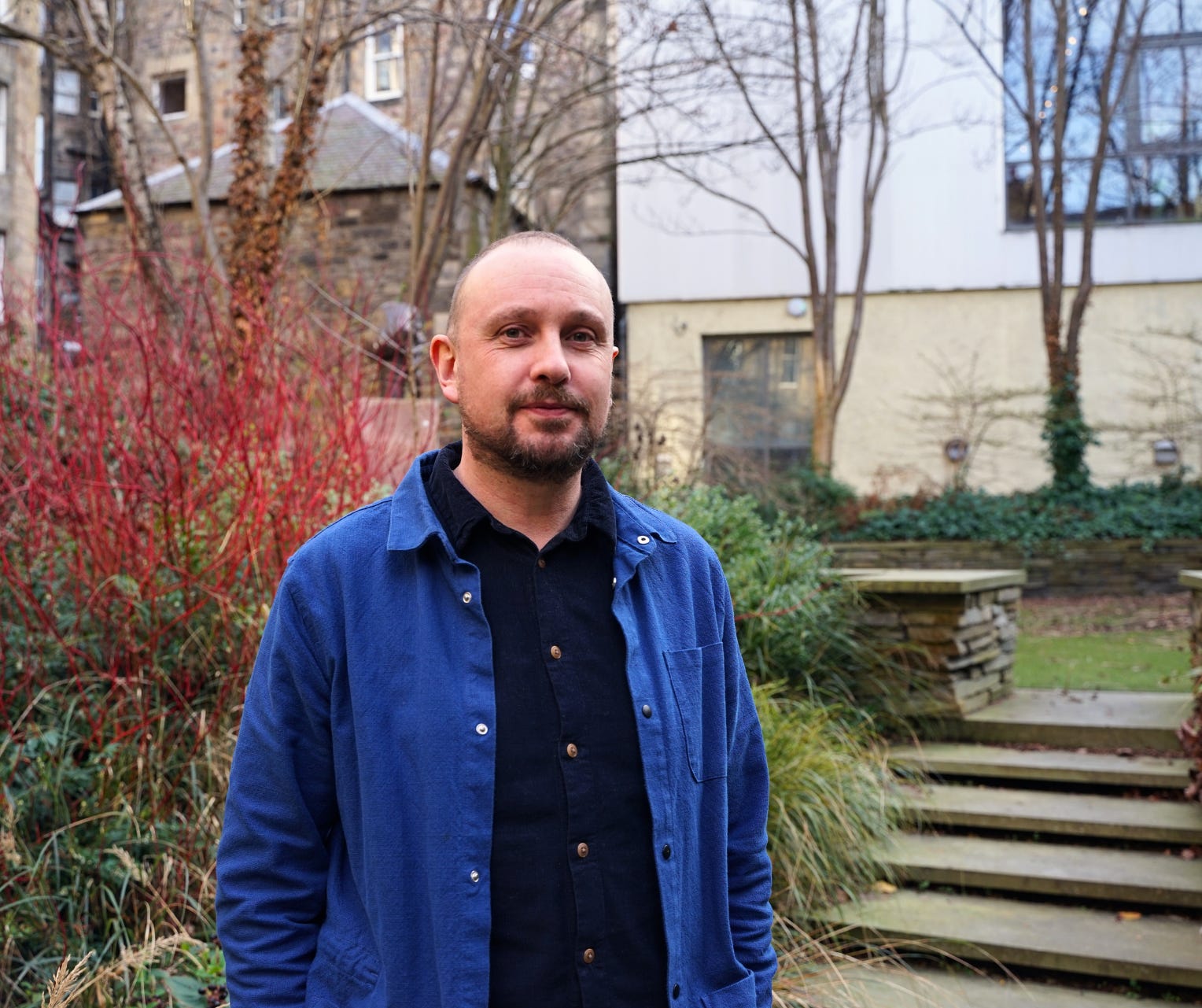
‘It’s a slightly odd situation for me; I’ve been involved in the festival for many years as a programmer running the Storytelling Centre and then as associate director,’ says Daniel Abercrombie when we sat down for a chat in the Centre cafe. ‘So in a way I understand the festival and know what works, but it’s really exciting for me to have it as my first as director with the buck stopping with me.’
This month brings an institutional changing of the guard to Edinburgh’s Royal Mile, and it’s not up at the castle. When the Scottish International Storytelling Festival opens its 2026 edition - running from 21 to 31 October - it does so without Dr Donald Smith in charge for the first time in 36 years, writes Will Quinn.
Founded in 1989, the event has expanded from an initial gathering of 700 attendees into the world’s largest celebration of the oral tradition, welcoming more than 40,000 visitors annually.
Abercrombie’s appointment, announced on World Storytelling Day by Traditional Arts and Culture Scotland (TRACS), represents a desired but not inevitable succession. Yet stepping into the shoes of the festival’s architect is an exacting task, especially with the simultaneous departure of longtime projects and programme manager Annalisa Salisu.
‘We lost two core members of staff in Donald, as the previous director, and Annalisa, who was our projects and programme manager,’ says Abercrombie. ‘So that has meant I’ve had to take on quite a bit of the planning myself, which is good because it’s given me a full overview of what’s happening in the festival.’
Daniel’s personal history with the Scottish Storytelling Centre mirrors the economic scarcity confronted by his predecessor decades earlier. After completing a master’s degree in cultural tourism focused on literature and visitor economies in Edinburgh, he found himself facing a frozen jobs market.
‘I’d completed my studies, all went well, and then couldn’t get a job,’ says Abercrombie. ‘It’s an age-old story. Couldn’t get a job, but I kept in touch with Donald, and he brought me along to help out with some volunteering, whilst he was helping to organise an Old Town festival around 2010.’
A programming role opened that autumn, and Abercrombie took it with both hands. Over the next sixteen years, he oversaw venue scheduling, ran its Edinburgh Festival Fringe output, and was part of the founding team of Edinburgh Tradfest in 2013. In other words, once upon a time, Daniel Abercrombie was a young man seeking his fortunes, who found a wise mentor, one he would ultimately succeed.
Frugal roots and community alliances
However, 21st-century life in the performing arts is anything but a fairytale. Working with progressively more constrained public funding requires an accommodation with tight resources. Fortunately, some might say, traditional storytelling carries a minimal technical footprint compared to mainstream theatre.
‘Our approach has always been limited on budget,’ notes Abercrombie. ‘Which is not always an issue because storytelling can operate on a small scale where almost all you need is to pay the storyteller.’
Yet long years of running a venue can lead to creative ossification. Practices and formats that worked a decade ago often persist simply because no one intervened to stop them. That’s true of all workplaces, and a centre for the performing arts is no exception.
The venue shutdown of March 2020, however, eliminated any risk of developing an institutional conveyor belt.
‘There was a major reset with COVID,’ Abercrombie explains. ‘That gave us - me in particular - a chance to reflect, but also a chance to stop doing things not because they weren’t working, but because we were forced to, which meant that we could really start with a clean page when we reopened.’
That forced hiatus reshaped his philosophy, gradually replacing top-down curation with authentic community partnerships. A notable post-lockdown example was Queer Folks’ Tales, developed alongside producer and storyteller Turan Ali.
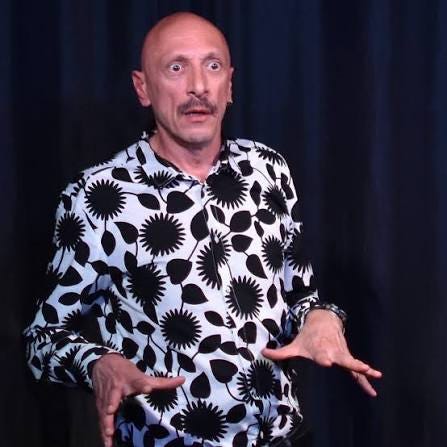
‘Turan approached us; that was not our idea, but something I had been exploring was around personal stories,’ Abercrombie says. ‘Turan had this great idea. We helped pull that together, got a bit of funding for it, and assisted with some of the programming. It’s gone from strength to strength. Now five years down the line, it’s a really great thing, but if we’d started a queer storytelling night ourselves, I don’t know if it would have had the same traction as coming directly from that community in partnership.’
More recently, he applied a similar community model to Moonspinners, a performance series anchored to the natural calendar.
‘It’s based on the Celtic Wheel of the Year and held under full moons,’ says Abercrombie. ‘They have a community meal before the event, the performance downstairs, and then come back into the court space for a social event with more performance. To me, that’s a perfect festival celebration.’
Having been so integral to the success of the Scottish Storytelling Centre, relinquishing the building’s day-to-day operations to his colleague Lauren Paterson, now interim Head of Programming, is proving something of an exercise in personal discipline.
‘Part of my difficulty is going to be not getting too involved in the centre,’ Abercrombie admits. ‘Allowing the centre space to breathe means I also have to manage my capacity and focus on October as well as year-round talent development where I can. I’ve already stepped back, and Lauren - who is fabulous - is doing what she’s going to do.’
What Abercrombie is going to do is take the opportunity to sketch out a longer-term strategy for the festival he now leads. With two-year funding secured through the Scottish Government’s Expanded Festivals Fund, he has breathing space to look beyond immediate administrative survival.
‘Which means I’m not spending my autumn panicking about what we’re going to do,’ he says. ‘So I am currently thinking about the future.’
Epic cycles and global bridges
It becomes clear as our chat progresses that the shift from assistant director to leader is fundamentally altering Abercrombie’s perspective. Not only are his strategic muscles being flexed more by the day, but now he must think of himself as a cultural diplomat.
‘The main benefit for me has been being able to think outside the four walls of the Storytelling Centre and consider what’s happening around the rest of the country,’ he says. ‘And now it’s more about me getting a real understanding of what’s going on out there.’
That wider remit includes joining the directors of Festivals Edinburgh, ensuring the oral tradition has a seat at the table alongside the city’s heavyweight arts institutions.
‘I think when you change your role and have director in your title, all of a sudden people look at you differently,’ Daniel says. ‘They expect different things from you, which at this point in my career I was ready for, involving myself more in those conversations. I’m heavily involved with Festivals Edinburgh, of which our festival is one of “The Eleven”. With that comes a lot of advocacy for the festival and cultural scene in Edinburgh.’
It also freed him to travel to Stockholm in June for the Federation of European Storytellers (FEST) conference, trading August Fringe preparation for international bridge-building.
‘Meeting people in person was a great opportunity,’ he says. ‘At that time of year I would previously have been stuck in Fringe programming or busy summer venue planning, so it’s been a really nice shift in perspective - not necessarily in pace, as it’s been busier than ever, but in perspective.’
Indeed, if you think Abercrombie’s new role is just a seasonal Edinburgh affair, think again. While the capital provides the media hub, the festival itself is fundamentally decentralised - a national undertaking spanning eleven days in Edinburgh and more than a hundred events rolling out across Scotland over two full months.
‘It is a Scottish International Storytelling Festival, so a big part of the message is that it’s around the country,’ Daniel explains. ‘It is a large festival: eleven days here in Edinburgh, but also across two months through the country, with over a hundred events across the whole of Scotland. I don’t think there are other [storytelling] festivals on that scale.’
With a few more levers now within reach from the director’s hot seat, he remains committed to the festival’s mission to foster long-term sector health, supporting regional networks such as the Grampian Association of Storytellers (GAS) and Dundee’s Blether Tay-gether.
‘They are actively doing storytelling year-round in their communities,’ says Abercrombie. ‘As part of the festival, we offer financial and promotional support to help them host their events and sometimes send guest storytellers their way. Part of what we want to do is keep this tradition alive in the communities where it’s happening and where the stories originate.’
This pursuit of a firmer national footprint is balanced by an ambitious approach to international programming in October. For Abercrombie, overseeing the festival’s foreign slate, previously outside his remit, marked a fresh curatorial frontier.
‘Having direct influence on the international elements is new for me,’ says Abercrombie. ‘I had always been involved in making that happen, but actually making the decisions on the storytellers, countries, and cultural partnerships we’re going to have this year is a fresh step.’
This year’s curated slate prioritises sustained bilateral relationships over one-off showcases, forging fresh connections alongside long-standing European partners.
‘Three Turkish storytellers will be coming over, and I’m hopeful this might be part of a two-year partnership and cultural exchange where Scottish storytellers can go over there,’ he says. ‘We also have two groups from Italy alongside Canadian, Irish, and English performers. It’s been really exciting to see what the Turkish and Italian storytellers bring.’
The 2026 programme also issues a rare, and welcome, challenge to audience endurance. Rather than condensing tales into sixty-minute slots, Abercrombie is reviving long-form, serialised mythology with the Scots-Irish Ossian cycle and a two-part St Columba cycle.
‘There’s been a desire for a while to try these epic stories,’ says Abercrombie. ‘For example, with the Ossian cycle, we’ve brought Scots and Irish storytellers together across three performances to share this cycle in its natural flow, placing it in Scotland while linking it to Ireland. We split it into three so people can buy a ticket for one part, two parts, or experience the whole thing.’
It is a direct nod to how ancestral audiences consumed story over consecutive evenings.
‘If you go back to older times, people across many different cultures would hear the storyteller tell these stories night after night,’ Abercrombie notes. ‘It was entertainment, a moral message, and a way of connecting with your community.’
Yet Abercrombie refuses to view these epic commissions as museum pieces confined to a single Edinburgh basement.
‘The theatre here has 99 seats, so if 99 people come and enjoy that, that’s great,’ he says. ‘But it’s also about raising awareness - someone might read about it and realise Scotland has these mythological cycles that could be explored. I’d be really keen to see if other traditional arts festivals are interested in hosting these performance cycles as well.’
His broader ambition is to see newly commissioned oral work travel onto Scotland’s premier arts stages, ensuring these performance cycles find a life long after October ends. The Scottish International Storytelling Festival might open and close every October, but the work of its director is never done.
