

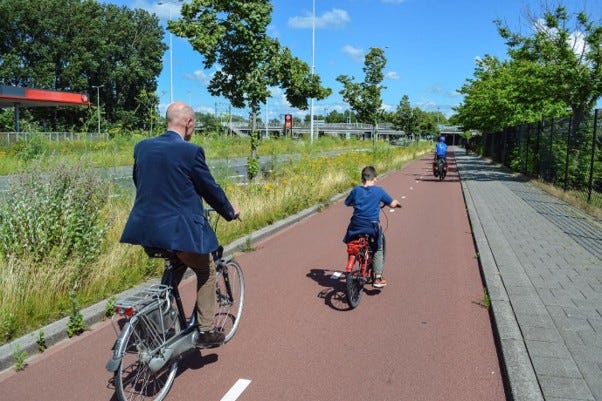
A cycling city is the vehicle to a wealthier, more equal city. Not just GDP and wages, but the kind of wealth that makes people happy: opportunities for those struggling, kids allowed to be kids, a lower cost of living, longer and healthier lives.
And happiness can be measured. People in Edinburgh and Glasgow who cycle to work are around 15% less likely to be prescribed antidepressants or anxiety medication, and exercise is roughly 1.5 times more effective against depression and anxiety than medication or counselling.
Edinburgh and the Lothians are Scotland’s fastest-growing population, and the Capital is an economic powerhouse that draws millions of tourists a year. Yet one foodbank in Leith has fed more than 44,000 people since 2014, nearly 8,000 of them children. A cycling city will not fix that. But it cuts the cost of the journeys nobody can avoid.
The Manifesto
Continuing to build safe, segregated cycling routes and funding fantastic programmes like Bikeability go without saying. But this is how Edinburgh can tackle congestion and poverty together.
This manifesto targets journeys that cannot be replaced by walking and is aimed at three groups: children getting to school, commuters driving to work, and households whose car dependency pushes them into poverty.
1. School Streets at every primary, and routes safe enough for an eight-year-old
2. Cycle networks to the train stations in the commuter towns
3. Cross-boundary cycle superhighways
The Carrot and The Stick
4. A paid-to-cycle scheme, the carrot
5. A congestion charge, the stick and the funder
The Mechanism
6. A regional transport authority
7. Multi-year active travel funding
8. 10% of the transport budget for active travel
9. The sustainable transport hierarchy actually followed
The Day the Cars Stopped
10. An annual car-free day, launched at the 2027 Grand Départ of the Tour de France
The Alternative
Meet Katie: P7, a creative and aspiring netball player, and until recently a junior road safety officer.
She would cycle to school tomorrow if we let her. ‘Bikes are relatively fast; they are a form of exercise, and I will get fresh air.’ She goes by car because somewhere between her mum’s house and the school gates is ‘a narrow, busy road which is inappropriate for pedestrians and cyclists’. Improving cycling infrastructure, like dedicated lanes and safe crossings, could make this route safe enough for Katie and classmates to walk or cycle, addressing safety concerns that currently prevent many from doing so.
Those are the findings of a feasibility study, not a primary school pupil.
Her school, in the south of Edinburgh, is one of only 14 of the city’s 91 primaries with a School Street, the road outside closed to traffic at each end of the day. Near the gates she feels safe: a side street, “not many cars”, signage telling drivers to ease off. Quiet route, low traffic, managed speeds, three of the conditions the design guidance asks for, observed by a P7.
What stops her is everything before that. The safe network is not there yet.
She did not put up with it, either. She stood for the road safety post because her school had nothing telling drivers to slow down, and named her dangers precisely: speeding, and cyclists never taught to ride. The signage is there now.
Katie, we salute you for your services to road safety.
Chris Bruntlett of the Dutch Cycling Embassy, whose book, “Building the Cycling City”, inspired this series, gives every city the same advice: “Start with your captive audience, because kids can’t drive.” The school run is one of the shortest trips a household makes, yet up to a third of morning traffic is parents delivering children to the gate. The number of kids being driven to school has never been higher.
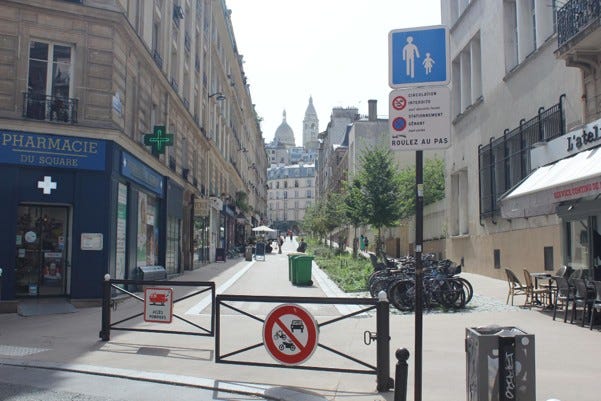
So build three things. First, School Streets at every primary, starting where the Walk Wheel Cycle Trust maps the streets that are both deprived and dangerous: West Pilton, Craigmillar, Wester Hailes, Niddrie. The families and children want to walk and cycle; the streets are the barrier. A review of more than 80 studies put it plainly: children did not choose to disappear; the streets were designed to exclude them to prevent road deaths.
Second, improve cycle networks to the train stations in the commuter towns. Around half of Dutch rail passengers arrive by bike, and at the far end the railway rents you the next one. At Musselburgh, Eskbank and Bathgate, 30 to 44% arrive by car and just 4 to 11% by bike.
Third, cross-boundary cycle superhighways for the roughly 63,000 who drive into Edinburgh daily. Most Lothian towns sit 8 to 16 kilometres out: on an e-bike, 25 to 45 minutes, and no bypass queue. The Netherlands are currently building thousands of kilometres of them, and they seem to know what they are doing.
Give drivers alternatives.
And the gain lands on the driver, not the cyclist. Every extra minute of commuting lowers job satisfaction. It worsens mental health, with one exception: people who walk or cycle do not lose their leisure-time satisfaction the way drivers do. Car congestion costs drivers literally days each year. The bike does not just move you. It gives you your life back.
