


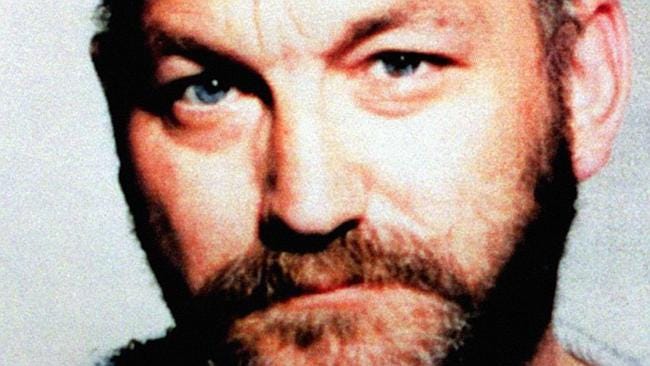
“If he hadn’t been caught, he would just have gone on and on and on…”
Even 43 years later, in the comfortable and bright surroundings of the Scottish National Portrait Gallery café in Queen Street the thought causes former Deputy Chief Constable Tom Wood and I to pause, because the man we are talking about is the notorious child serial killer Robert Black, once Britain’s most wanted man.
The story of Black and the groundbreaking police investigation which caught him is told in Wood’s new book “Sex, Spies and Bloody Murder”, which covers some famous criminal cases, several of which he was directly involved in. One of these was Black. He was a delivery driver who was intimate with the UK road network, spending countless days on the road in his dirty and unkempt van.
At its height the case involved six police forces and thanks to Hector Clark, who was in overall command, became pioneering in the use of computers in building a case against a suspect and helped shape the development of the HOLMES system now used in complex and multi-force investigations.
Tom said: “We knew a lot about him – we knew he was a driver of some kind, he was a paedophile, he was a snatcher, and we knew he travelled regularly between Scotland and England. What we didn’t know was his name, or where he lived.”
Apex predator
“Black was an apex predator. I spoke at length about the case with Hector and he was in no doubt. If Black hadn’t been caught, he would just have gone on and on and on. I spoke with another of the senior investigators, and he described Black as a like a heat-seeking missile. Any time he was out and about, he was seeking opportunity.”
The abductor and killer of at least four young girls – Susan Maxwell (11), Caroline Hogg (5), Sarah Harper (10) and Jennifer Cardy (9) - Black died in a Northern Ireland prison ten years ago of a heart attack at the age of 68. When he died, police were close to also charging him with the 1978 murder of Devon paper girl Genette Tate, who was 13.

Wood’s admiration for the way in which Clark led the investigation is front and centre. “Hector was the best detective I ever knew. He had been involved earlier in the Peter Sutcliffe investigations (the notorious Yorkshire Ripper serial killer) and told me that in pursuing that case good detectives had been let down by bad systems. Sutcliffe came to the attention of police nine times during the investigation, but because of the complexity of the case involving several forces using old card index systems he was not flagged up as he would have been by better systems. Several women died after he had first come to police attention. Hector was determined to do everything he could to avoid that happening again.”
The role of Hector Clark
Clark, then Assistant Chief Constable of Northumbria Police, knew that Lothian and Borders had just installed a new computer system, and approached Chief Constable William Sutherland in Edinburgh for permission to use the computer for the Caroline Hogg case. Special software was developed, and it became the first murder investigation to be computerised with terminals in Edinburgh and in Leicestershire, where her body had been found. The system established was to prove invaluable after Black’s arrest in building the case against him and would help shape HOLMES, the Home Office computer system which was in the process of being developed. It would be used later in the investigation.
Clark would himself go on to become Deputy Chief Constable of Lothian and Borders under Sir William Sutherland.
Black’s arrest happened in 1990 in the most dramatic fashion at Stow, in the border country south of Edinburgh, when police officers responded to a call from a local resident that a young girl had been abducted in a van.
Extraordinary arrest
One of the officers responding had special reason to fear what was happening. His daughter matched the description and was returning home from school at that time. The call had been made by a neighbour.
He and a colleague were first on the scene. They were speaking to the neighbour when the van reappeared on the A7 through the village. The officers stopped it, and the local policemen opened the van doors.
Tom takes up the story in his book: “At first the officer saw only a jumble of old boxes and rubbish, nothing apparently suspicious. But he persevered until under all the old boxes he found what appeared to be an old sleeping bag. Opening it, he found the barely conscious body of a young girl, her mouth taped shut, her arms and legs bound. Ripping off the gag to let the girl breathe, the officer confirmed what he had feared since he received the original call and the description of the girl. The barely conscious girl, the victim of the abduction, was his own daughter.”
I ask Tom how the officer was able to restrain himself at that point. “I spoke to him about that later. In reality, his priority was totally human. He just wanted to get his daughter, to find her alive and he was just so shocked and relieved. By the time he’d done that there were other officers on the scene dealing with Black.”
A life-saving legacy
After his arrest, the investigation focused on building the case against Black. By this time, the HOLMES system was up and running. Through a combination of the information that had been fed into the computer, and through the detailed record keeping of the company which employed Black, the investigation was able to place him at or close to the scene of the crimes on each occasion.
Yet the full extent of his killing may never be confirmed. The investigation was able to place Black at, or close to, the disappearances of young girls across Europe, crimes he never admitted to or faced charges in relation to.
While incarcerated, he was interviewed at length by renowned criminal psychologist Ray Wyre. As a final question, Wyre asked Black what more parents could do to protect their children. His response was chilling: “Never take their eyes off their kids, I suppose.”
The is far more positive legacy, however, from the work of those detectives. Their far-sighted approach ensured a methodical, computerised approach became a basic part of policing sooner than it otherwise might have done. As a result, countless lives may have been saved across the country.