



It was a freezing cold early evening when a young couple started to walk down the busy Shandwick Place, in Edinburgh’s West End. They were heading towards their fashionable home at 4b Heriot Row, one in a row of terraced grey stone houses.
This young, smartly dressed couple were the sort to attract glances as they walked past, writes Rebecca Batley.
He was a young and dashing lieutenant, with a reputation for being both upstanding and brilliant. Always immaculately turned out, more than one lady had batted her eyelashes at him that day, but accompanying him was, his young, pretty wife of only two years, Ruby.
She was dressed for the weather in a thick sealskin coat, trimmed with fox fur and beneath her coat she wore a black velvet suit jacket and skirt, her outfit was completed with a necklace of luminous pearls, fastened with a diamond clasp about her neck.
Every inch the society lady.
They walked briskly, passing a series of fashionable shops, displaying their wares, hats in Thompsons, foaming honeycomb at Carters, made in the window as children looked on. People bustled past hurrying home, anxious to get inside before the forecast change in the weather.
“I need to pop into Boots,” the Lieutenant whispered to his wife. She nodded and let go of his arm as he walked briskly towards the door.
“I’ll wait here,” she called, and he raised his hand in acknowledgement, not bothering to turn around.
Ruby stood there, people watching, her shoe tapping absently on the pavement. The air was filled with sugar and smoke, a nod to the industry that clogged the lower part of the city, but she had no knowledge of that. Ruby was a woman who preferred to be seen in, rather than to see the world.
But at that moment she was not seen, in fact she was invisible. No one saw the man who seized her by the throat, who pressed his hands so deeply into her neck that marks were left and who ran off at breakneck speed clutching her pearls. Staring into his wife’s pale face Lieutenant Cameron touched her frozen cheeks, ran his hands over her neck. His heart was pounding, looking left and right as gradually people began to watch them again.
“What happened?” he asked her, and then: “Call the police!”
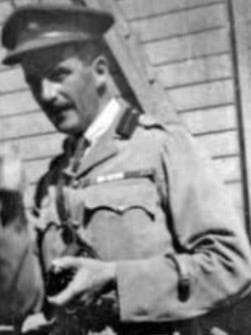
The Edinburgh season’s shining couple
The Edinburgh police force in the early 1900’s was a force to be reckoned with. It had a reputation for efficiency and several ex-military men were running the show. Many of these men were prominent figures in fashionable society, cashing in on their heroic credentials. It was a society in which Lieutenant Cecil Aylmer Cameron felt eminently comfortable. The military ran deep in his blood, the family tradition going right back beyond Waterloo, where his great grandfather had lost an arm, yet got back up to fight. His father Aylmer Spicer Cameron had been awarded the VC for his bravery on behalf of the empire in India, in an action which had cost him his hand. He was feted in all sections of society, and indeed his VC is still given pride of place in the Highlanders Museum. As a young boy Cecil Cameron had been raised alongside his five elder brothers on stories of his father’s bravery, of battles and glory, of kings and empires. If ever a man was born for the empire, it was him.
He was taught to shoot before he reached his teens, accompanying his family on hunting trips and to ranges. He was studious and dedicated, a boy quick to temper and sometimes difficult to like but fiercely loyal to his friends. By 1901 Cecil Cameron had joined the military, having been thoroughly prepared by an education at Bath Naval College and Woolwich Military Academy. His brothers were already serving in the Boer war and with the prospect of European war looming he was anxious to get in on the action. Unsurprisingly he quickly made a good impression, rising through the ranks and receiving commendations.
Then in summer 1908 he met a young Irish belle Ruby Shaw at a dance and his life changed forever. The young, beautiful Ruby was the daughter of a retired bank manager who doted on his daughter. A year later, on the 3rd June 1909 the couple married at St Michael’s church in Pimlico, both were 26 years old. They returned to Scotland and by 1910 were living in Edinburgh at Heriot Row, but there is some evidence that almost immediately all was not quite well with the young couple.
Ruby seems to have suffered from gynaecological issues. She likely had a miscarriage within the first year of their marriage and both her physical and mental health suffered, which made her husband fiercely protective of her. Ruby however threw herself into Edinburgh society, perhaps to distract herself but also to help forge relationships which could help further her husband’s career, at a time when promotions were still often made on personal preference rather than ability. They were the Edinburgh season’s shining couple, admired and feted wherever they went. It was against this backdrop that Ruby and her husband took a stroll that day and her pearl necklace was apparently stolen.
Such a high profile crime immediately drew attention and the next day not only were Lieutenant Cameron and his wife interviewed repeatedly by the city police but reporters also turned up at the door of their flat. One recalled the next day how he had been shown inside and found Cameron standing by the window of his flat. He had been wearing his “Royal Field Artillery uniform of blue with a red stripe horizontal.” The reporter called him the “handsomest officer (I) had ever seen (with) blueish eyes, a boyish air to his aristocratic features.” However the reporter also noted one other thing, which he drew to the city’s wider attention: The fact that Lieutenant Cameron was also “dreadfully worried and fidgeted as he spoke.” Perhaps his wife had already told him the truth.
Prompted by the suspicions of Lloyd’s bank who had insured the pearls it took less than a week for the police force to pull apart the Cameron’s story. By May, the Camerons found themselves in court. The charge against them was that the entire robbery had been staged so that they could fraudulently claim the £6500 for which Ruby Cameron had them insured.
The pearls had belonged to Ruby Cameron and had not been a gift from her husband, rather she claimed that they had been given them by a close friend “Billy Walker’‘, whose daughter had died of diphtheria. When she had been in India he had kept them but now safely in Britain she claimed them to wear. Their value was great so upon arriving in Edinburgh she had asked that a fake set of pearls be made. That meant she could still appear to wear them but without risk and she would hide the real ones away. She had later instructed the same jeweller to issue a value of £6000 for them, for insurance purposes, and she took out insurance to that effect with Lloyds bank. Ruby wrote that she “was anxious that they be insured at once.” The timing of the ‘theft’ immediately following these events quickly raised alarm bells with the police.
The first question they asked was whether Ruby Cameron had ever had such a pearl necklace and whether or not she had “used some other contrivance” to get them insured. Her claim that they had been a gift from “Billy Walker”, who rather conveniently had allegedly gone to darkest Africa. The police argued that even if this was the case then there must be some trace of him, but none could be found. Ruby Cameron claimed to possess letters written by him but the prosecution, having consulted experts, concluded that “the Billy Walker letters were written by Mrs Cameron.” They argued that Ruby Cameron and her husband had borrowed a real pearl necklace from someone or from Carrington’s jewellers whilst in London and had had a mock up made, using the real ones simply to show the insurers. The false pearls they claimed were the ones that Ruby was seen to wear wherever she went out.
Once the insurance was in place and the false necklace made, the police claimed that “the two accused, acting in concert, did pretend to the police that the necklace had been stolen from the person of Ruby Cameron and did also claim to the underwriters that a robbery had taken place….entitled Ruby Cameron to a payment of £6500.”
A ‘box office’ trial
The trial took place over six days in June during which the weather was stiflingly hot and the courtroom packed. The entire city had been gripped by the case, featuring two of its most glamorous and fashionable residents, and there was standing room only in the public gallery. Amongst those attending the court were those “society ladies” who had welcomed Ruby into their social circles and admired her stunning pearls. Rumours spread amongst them like wildfire, some arguing that Ruby had tricked her besotted husband, others that the ‘wicked’ lieutenant had manipulated his beautiful wife. Whatever they thought, both sides packed into the courtroom to hear the evidence and hear what the verdict would be.
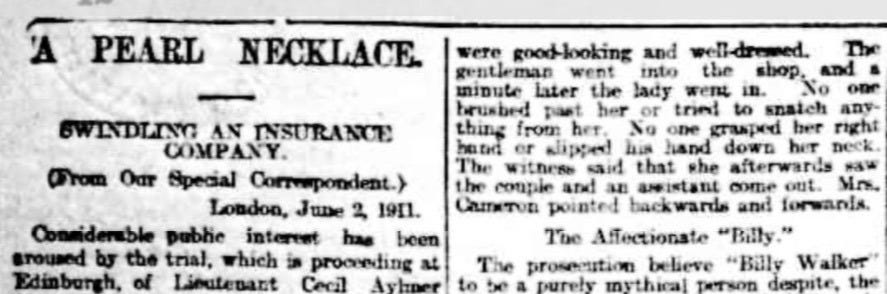
For their part Lieutenant Cameron and Ruby stood in the dock silently. The prosecution was well put together and capably presented. They argued there was not a shred of evidence to suggest Ruby Cameron had been robbed, and that the ‘pearls’ were still in their possession. Witnesses called included two young girls who had been in the street that evening and had seen the “good looking and well dressed” couple. When questioned about the alleged robbery they agreed Lieutenant Cameron had gone into the chemist but claimed that they saw no one brush past Ruby. Nor did they see anyone go near her and Ruby “did not utter a cry of any sort. No (they said) she never appeared to faint or stagger against the window.”
Another witness John Stuart claimed Mrs Cameron was “not perturbed” and that there “was no disarrangement of her dress.” Yet another witness, Flora McNeil, a servant who was out walking when she saw the Camerons, stated clearly “no one brushed past (Ruby) or tried to snatch anything from her. No one grasped her hand or slipped a hand down her neck.”
Ruby Cameron’s conduct was heavily scrutinised. The next witness Earnest Hayward, a former employee of a jewellers in Regent Street London, was even more damning. He was the man Ruby had approached to make a second set of pearls and clarified the pearls she had been wearing could have been “either the real or the imitation ones supplied by Messrs Carrington.”
Ruby’s maid Ernestine Tenca told the court that whilst in London Mrs Cameron had worn a diamond necklace everyday, but that she had received several packages from Carringtons, which went back and forth. She was not aware of an imitation pearl necklace having been made. Mrs Cameron had claimed to police the real necklace had been stored in a safe at a friend’s house, yet she was unable to produce this friend as a witness or offer a credible name.
A glittering career and fortune in the balance
This was a case the presiding judge Lord Dundra took very seriously. He knew full well that the verdict had the power to destroy the career of a young promising officer with family fortune and connection. Although pressed by him to do so, Lieutenant Cameron staunchly refused to give evidence in his own defence.
At what point he had learnt the truth is not clear, Ruby Cameron’s later confession would testify to his complete ignorance of the fraudulent plan, but he refused to save himself at the expense of his wife.
The jury were convinced by the prosecution and they took little time to return a verdict of guilty leaving Lord Dundra no choice but to pass a custodial sentence of three years. Lieutenant Cameron and Ruby were to be detained at his majesty’s pleasure in “penal servitude.” Lord Dundra’s voice contained “a tremor…as he sentenced the two young society favourites.”
One reporter recalled how, from the courthouse, the prison van “rumbled past, and we knew that inside were the young officer and the beautiful young Irishwoman sitting amid the ruins of all their hopes and dreams.” The news of their guilt was reported as far away as Australia.
Within six months Ruby Cameron was released from prison on health grounds. She confessed quickly that her husband had had no knowledge of the crime, that she had planned it herself and that he was simply protecting her. It was not enough to secure his release and he served his full three-year sentence.
A petition however was raised, demanding he be given a full pardon. It was signed on his behalf by amongst others 126 generals, five dukes and 20 politicians. He was granted a full pardon and upon his release was permitted to resume his military career with the rank of Lieutenant.
Cameron went on to serve in the First World War with distinction. He was mentioned four times in dispatches and awarded the DSO (Distinguished Service Order) for his valiant conduct. All of which helped to conceal his real role.
He became, in the words of the Military Intelligence Agency, “Britain’s Greatest Spymaster” and from Folkestone headed the British part of the tripartite intelligence network. He was responsible for training and running agents in occupied France and Belgium. His code name was Evelyn, incidentally the name he would later give his and Ruby’s only son, he also went by “B.”
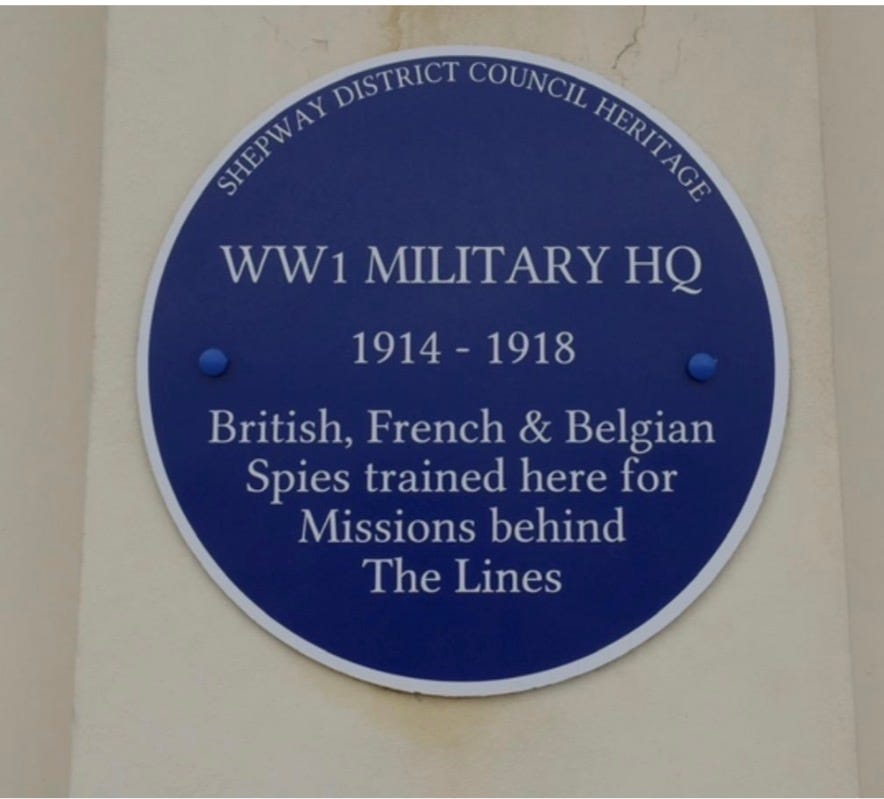
From Folkestone he ran what today is called the Alice network which operated in France under the indomitable Louise de Bettignes who used the codename Alice Dubois. Together they helped to set up an extensive and complex network of spies and to smuggle out as many allied prisoners as they could. The information the Alice network gathered it is claimed shortened the war by as much as two years and it led to the destruction of numerous German batteries and narrowly missed killing the Kaiser himself.
Louise de Bettignes was operating under Cameron’s orders when she was captured in Brussels. She would later die in prison. Cameron’s second most famous recruit was Leon Trulin who, having brought Cameron valuable information on German units and weaponry operating in Belgium, was sent back only to be caught and shot at just 18 years old.
For his service and bravery honours were heaped on Cameron including the Legion d’Honneur, the Croix de Chevalier and the Belgian Order of King Leopold. Following the First World War he headed the British Military Mission to Siberia in the Russian civil war where he once again headed Military Intelligence. The now Major Cameron spent little time at home with either his wife or his son, who had been born in 1916. In 1922, he was sent to Ireland which at the time was experiencing serious unrest ahead of the setting up of the Irish Free State. He trained over 60 intelligence officers who were sent into Ireland.
A year later, he was offered the prestigious post of military attache to Riga, but this was countermanded on the orders of Lord Jellicoe and Prime Minister Ramsey Macdonald. They both objected to a convicted criminal being given such a position.
The decision devastated Cameron. He resigned his commission on the 14th August 1924, heavily in debt, and it now seems clear suffering from severe PTSD. Four days later, he was found at Hillsborough Barracks, having “shot himself to death.” His funeral, held at Burngrave cemetery was attended by a large number of people, many of whom lamented that the promising young man had, despite his subsequent service to Britain, been able to escape the events of that cold Edinburgh day.
Fascinating, tragic and yet deeply intriguing, this is how the fabric of a city is woven. Wonderful research & well written!